Tactical Worldbuilding
Donovia, Atropia and the imaginary infrastructure of modern war
The U.S. Army maintains a built world. The Decisive Action Training Environment — twenty-four fictional countries, from Donovia (definitely not Russia) to Ariana (definitely not Iran) — gives every unclassified exercise a shared, editable stage, documented on an official wiki and revised through a formal approval process. Reading it the way a fan reads Warhammer lore, this essay follows DATE’s patch notes: a Turkish general’s complaint that redrew a border and rewrote a fictional genocide, a Donovia merged into one state to match what the Army saw in Eastern Europe, and the reconfigurable plywood town at Fort Irwin where the fiction has to stay put.
It then leaves the base for Pineland, the Special Forces training country that shares real roads with people who aren’t playing, and the 2002 Robin Sage exercise in which a sheriff’s deputy shot two soldiers who thought he was part of the story. Fictional countries are allowed fictional histories; the question is what the Army chose to keep, and who it chose to make responsible.
![At the request of the Atropian government [Image 1 of 11], overlaid with geospatial data of DATE’s Caucasus region. Sources: SFC William Howard, ODIN.](https://substackcdn.com/image/fetch/w_1400,c_limit,f_webp,q_auto:good/https%3A%2F%2Fsubstack-post-media.s3.amazonaws.com%2Fpublic%2Fimages%2F63480152-5550-4bd8-b29b-c29e55189399_1600x1067.png)
I’ve always held that you can tell everything you need to know about a “built world” from the depth and breadth of its fan wikis—perhaps best exemplified by the sprawling network of time-devouring sites that document the lore of Warhammer 40,000. You might start by looking up a character whose name you half-remember from a bit of box art, scroll through the wars they’re confirmed to have fought in, then follow a few hyperlinks to a planet one of those battles was fought over and the governor who oversaw the wider sector three thousand years before that. Eventually, if you are me, you will lose a full hour of mission-critical 10th-grade school-night sleep reading about some barely canonical alien schism that was originally conceived to explain why one sub-faction has a slightly different color scheme. No single page matters much; the joy comes from knowing there’s always a dozen more lines of clickable blue text behind it. When my phone introduced me to the United Republics of Donovia, I felt the same pull right away.
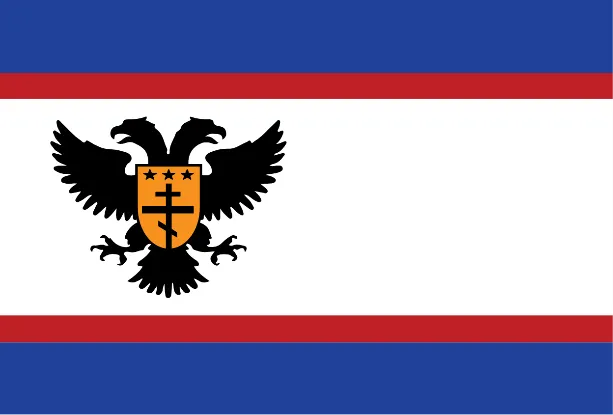
Donovia is the largest country on Earth, spanning eleven time zones from Kaliningrad to Kamchatka, with its capital in Moscow. Its history includes the rise and fall of the United Federation of Socialist Republics, followed by the emergence of a small group of oligarchs with power over a nominally democratic but highly authoritarian government. It has significant conventional military and nuclear forces, abundant natural resources, a bad habit of leaning on smaller neighbors and a bit of a complex about Western powers doing the same. Its largest city has 12.5 million people and is, again, Moscow.
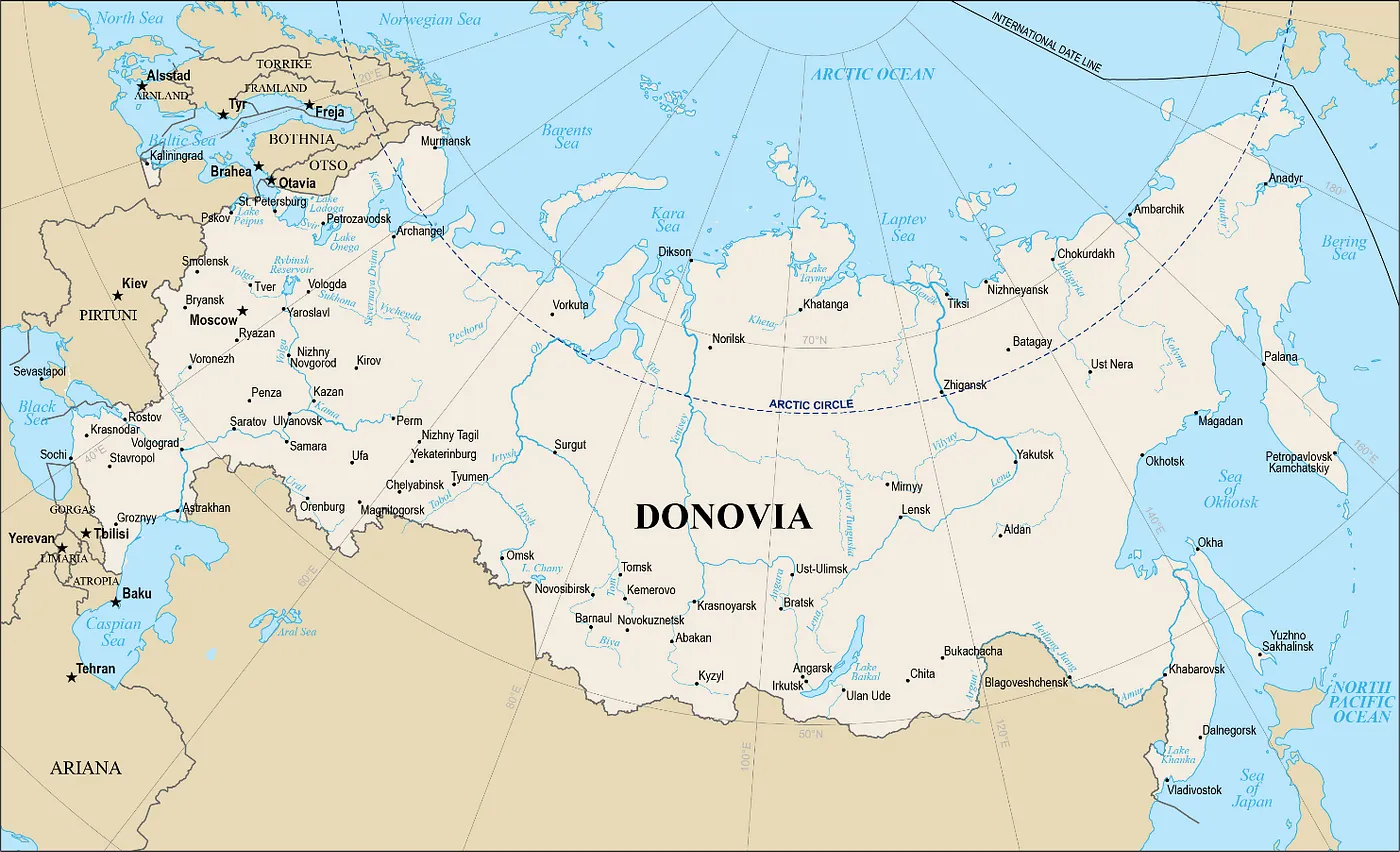
If any of this sounds familiar, it’s because the architects of Donovia have never been terribly concerned with hiding the bit. The country’s southern neighbors include the pro-Western autocratic Republic of Atropia and the impoverished Democratic Republic of Limaria, which have fought several wiki pages’ worth of wars over a contested territory called Lower Janga. To the west, in the world’s only current “legacy” region, are the daughters of the former Skolkan Empire: the Republic of Torrike, the Kingdom of Framland, the Royal Duchy of Otso, and the Bothnian Democratic Republic. The history and maps of each country are awfully close to our own, though there’s no clear point of divergence. This is the world of the Decisive Action Training Environment: a shared, unclassified foundation for building everything from small-scale U.S. Army educational exercises to multinational training events.
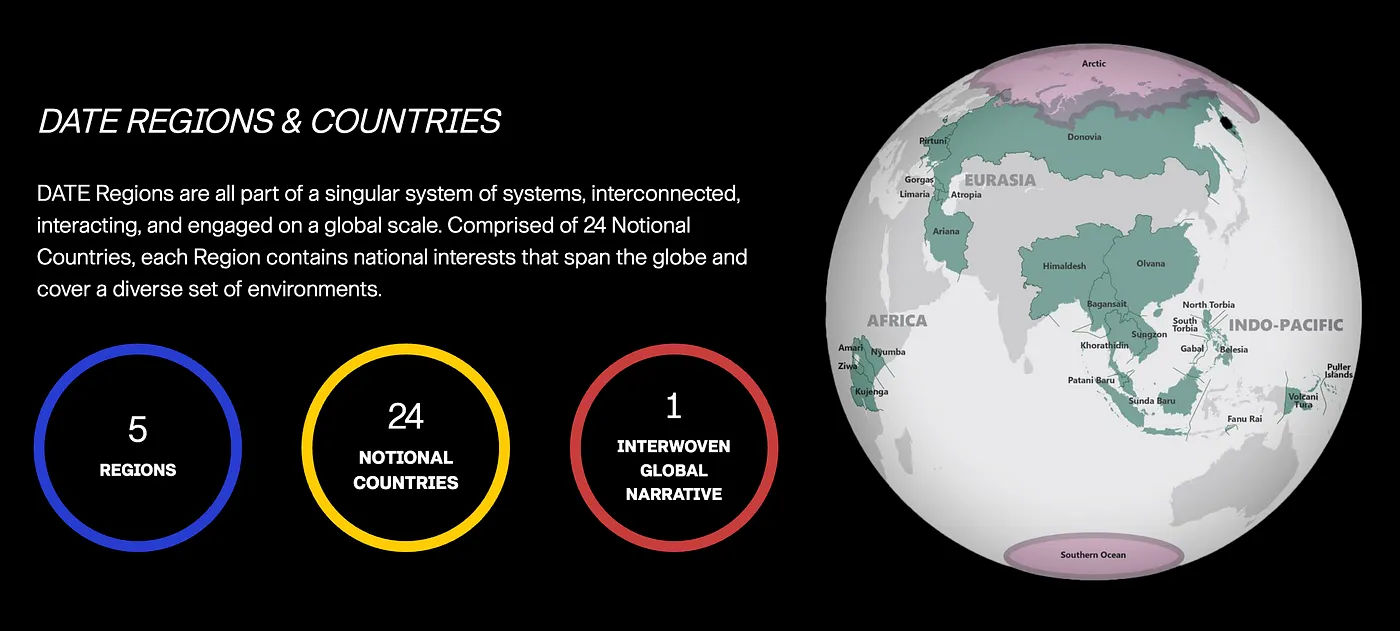
DATE’s definitive wiki lives on ODIN, the U.S. Army’s Operational Environment Data Integration Network, alongside databases of military equipment, threat force structures and downloadable geospatial data. It tickles me to think that at least one person out there may eventually get priority airline boarding and Outback Steakhouse discounts partly in recognition of their service to the Donovia ODIN page—and, honestly, they’d deserve it. The whole site passes my clickable-blue-text test with flying colors, although it’s hard to compare it to the “fan” wikis of Warhammer. The people maintaining this canon have training requirements to meet.
Why Pretend?
While most contemporary built worlds exist to add background flavor for tabletop games and cinematic universes, DATE is a lot more functional by design. Created from the earlier Full Spectrum Training Environment in 2011, the Army’s in-house built world currently features five distinct regions and twenty-four countries, each borrowing and combining real-world capabilities organized under PMESII-PT—Political, Military, Economic, Social, Information, Infrastructure, Physical Environment and Time. Its architects are unusually insistent about what this produces.
DATE World is the U.S. Army’s official training environment. It provides the Army training community with a singular, unified, scalable training environment that facilitates training scenarios across live, virtual, and constructive events. It’s complicated, we know, but words have meaning after all and environment ≠ scenario (be sure to read this portion aloud in the most condescending manner, lest anyone forget that words have meaning). DATE World is the environment within which any theoretical scenario may take place. Therefore DATE World is not a scenario…it’s simply the imaginary place where training scenarios transpire.
The above quote comes verbatim — bolding and all — from a 2022 explainer published to the DATE World Users’ Blog. The very next heading is, “Why Pretend?”
The straightforward answer is diplomacy: if you buy a punching bag with your neighbor’s face on it, it may inspire some awkward conversations at your next HOA meeting. The Army’s current opposing-force regulations explicitly warn that foreign governments read U.S. scenario choices as signals — or warnings — and its rules generally require fictional enemies for unclassified exercises outside ongoing conflicts. Fictional national interests can resemble real ones as long as they’re not 1:1, while fictional diplomacy “must not compromise” U.S. relationships with real-world governments. However, real terrain, cities and infrastructure remain fair game.
This is not the DATE blog’s first answer. Instead, its authors start with a practical problem: “Real-world environments are constrained by, well, reality.” The actual Russian military is under no obligation to present the exact combination of threats a brigade might want to practice against. This is what gives Donovia more utility than simply writing “DEFINITELY NOT RUSSIA” on a map; it can resemble its referent while remaining editable, even if some limits still apply. You can shut down the Moscow metro because of a labor dispute or a natural disaster, but you can’t simply rule that the city has never had a metro at all.
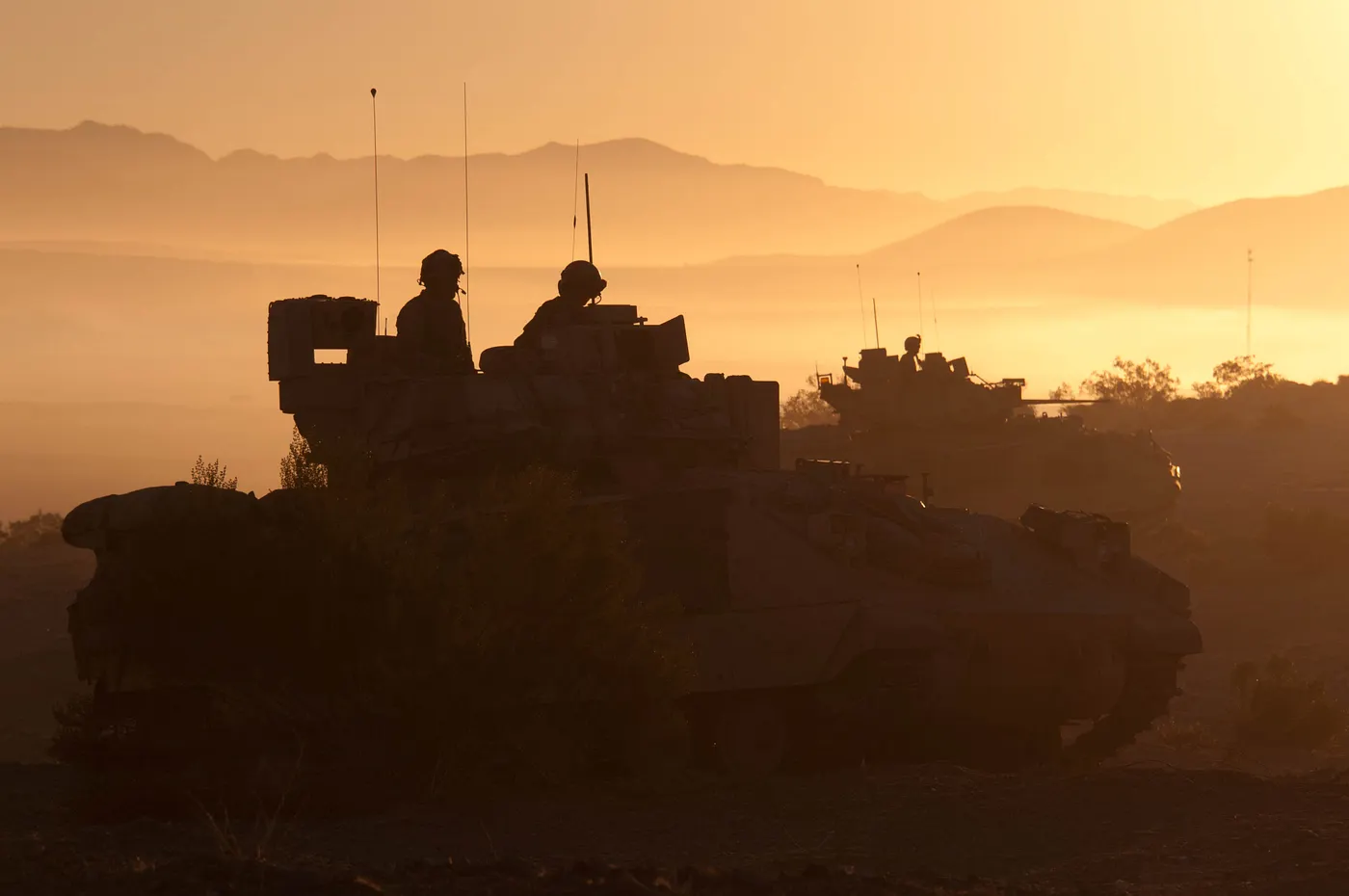
Just as the fictional city of Baldur’s Gate exists beyond a single Dungeons & Dragons session, Donovia exists before and after an Army instructor decides to set a scenario there. Moscow might suffer a transit workers’ strike in one exercise and an invasion in another. Still, some things — like a vast network of tunnels that double as bomb shelters — remain taken for granted. This lets different instructors, units and militaries use different parts of the same country without creating chapters in one continuous war.
The core appeal of a shared built world, much like the core appeal of a given tabletop gaming setting or the whole idea of fanfiction, is that it spares you the work of inventing your own, at the price of accepting quite a lot of someone else’s. By giving that work a persistent reference world, maintained on a public website, DATE turns imagination into infrastructure. But infrastructure requires maintenance.
Patching a Genocide
DATE’s main steward is the Army intelligence directorate T2COM G2, formerly TRADOC G2. Its writers work with intelligence assessments, doctrine and the requirements of the people who will use the countries they invent, which means that every DATE update has a bracingly official approval process. I’m sure Warhammer would, too, if Games Workshop’s stakeholders included most of NATO.
Sometimes the stakeholders have feedback. In a 2017 article titled “After Multiple Invasions, the U.S. Army Is Getting Tired of Liberating Atropia,” the Wall Street Journal reported that Turkey’s top general had written to the head of U.S. European Command in 2014 specifically to complain that the DATE World had placed a historically Turkish town inside the borders of Minaria, a country definitely not based on Armenia, rather than Kemalia, a country definitely not based on Turkey. An unnamed U.S. official told the paper the episode had caused a “diplomatic kerfuffle.”
In the next version of DATE, published in 2015, Minaria and Kemalia were renamed Limaria and Kalaria, and the contested region of Artzak became Lower Janga. Borders were adjusted between Ariana, Gorgas and Limaria, which required updates to each nation’s road mileage and arable land totals. Alongside these relatively sober game design tweaks, all references to the Ottoman Empire were also removed—along with a fairly significant fictional historical event.
The greatest change in Limaria – besides the new name and borders – is the removal of an attempted genocide by the country of Kalaria. Instead, the Limarian animosity toward Kalaria is due to a dispute between the two countries following the summer 1943 massacre of a Kalarian scientific expedition to Mount Ararat – then part of Limaria. The subsequent actions of the Limarian military initiated a month-long conflict, which was resolved by the League of Nations in 1944 and resulted in Limaria surrendering its southern province of Noah – which contained Mount Ararat – as a condition to peace.
These edits continue in the “Social” section of DATE 2.2’s Limaria dossier, which explains that Limarians accept blame for the massacre but regard Kalaria’s response as excessive. The “Time” section still advises anyone dealing with Limarians to understand “the extreme hatred developed over the centuries” that most of them hold for Kalarians, and the Limarian calendar lists April 24 as “Ararat Remembrance Day,” honoring those killed in the fictional 1943 conflict. For those of you taking notes, this is also the day when real-world Armenians commemorate the victims of the real-world Armenian Genocide.
The Army has never gone on record about what prompted these updates, but I have my suspicions. We may be talking about the head of a real nation’s real military filing a real complaint to another real country about the borders of a fictional map, which prompted a change to that map and the invented history behind it. For all the appeal of pretending, these imaginary countries can still carry plenty of real-world charge.
The rabbit hole doesn’t end there. The revision notes in DATE 3.0, published in 2017, list the following changes.
Borders—Borders for Ariana, Gorgas, and Limaria have been restored to those used in DATE 2.1, as shown below. All maps in the document have been updated to reflect these changes. Related information, such as road miles and percentage of arable land, have also been revised in the affected countries.
Kalaria—All mentions of Kalaria, including its citizens, ethnicity, and language, have been removed from the DATE. Text discussing Limarian conflict with Kalaria has also been removed, resulting in Limaria’s main focus being limited to one DATE country—Atropia.
Real-World Countries—All mention of named non-DATE border countries has been removed from the DATE. Most of these mentions have been removed in their entirety. In a few select instances, text referring to a specific country has been modified to refer to an “eastern neighbor” or “regional conflict.” All maps were revised to eliminate defined borders for non-DATE countries. In addition, mention of other real-world countries not bordering DATE OEs has also been minimized, and all references to the Global War on Terror (GWOT) and Operations Enduring Freedom (OEF) and Iraqi Freedom (OIF) have been removed.
Personally, I can’t help wondering if DATE’s architects just got tired of real-world Turkey backseat-directing their world.
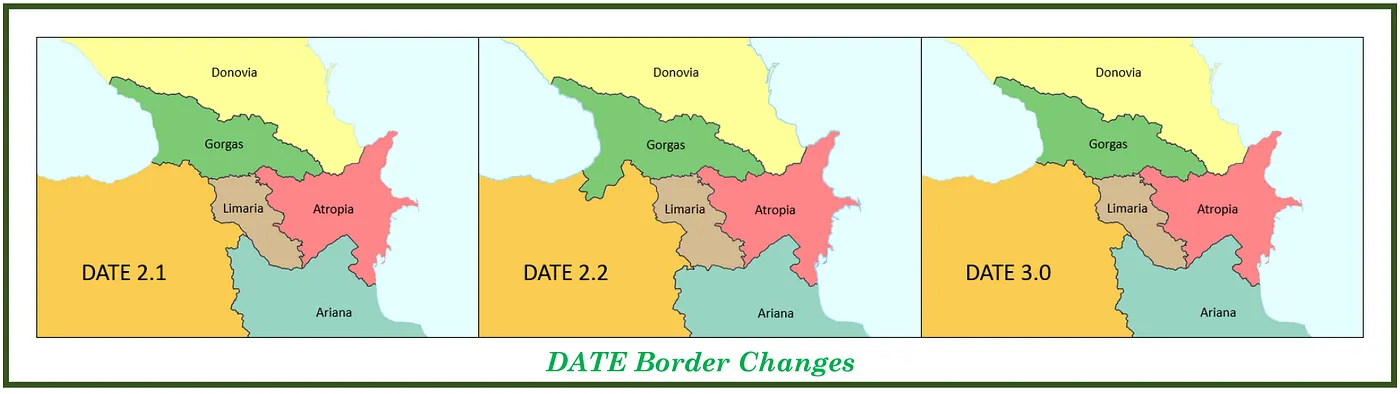
Since then, the edits appear to have continued. Limaria’s current Time page sets April 24 aside for “Limarian Genocide Remembrance Day,” one of the country’s twelve non-working holidays, while the Social page lists Tsitsernakaberd as the “Limarian Genocide Memorial,” dedicated to the victims of a Limarian Genocide during the First World War. Further backstory cites persecution at the hands of the Ottoman Empire — they’re back, too — in the late 19th and early 20th centuries, with refugees during and after the war described as “escaping attacks” that no specific country is named as making. Turkey appears under its own name as a country that closed its border with Limaria in the 1990s over the Lower Janga War “in support of its ethnic kinsmen.” Kalaria is also back in a few politically consequential references, perhaps most curiously on the Eurasian regional overview page — “Loss of territory to Kalaria influences all decisions” — and the main page for Gorgas, where it is cited as one of the reasons for an ongoing embargo against Limaria. It’s also cited on Limaria’s Physical Environment page as the habitat of several snake species.

How DATE’s architects expect anyone to put this together, I have no idea. A genocide is back as a holiday and a memorial, along with the Ottomans and Kalaria, despite all three having been officially written out of the world for years. The current dossier leaves you — the would-be trainer or scenario planner — to work out how the territorial loss that supposedly influences all of Limaria’s decisions fits into the history it has brought back. Meanwhile, the 2015 change in responsibility for the shapeshifting Bad Event in Limaria’s past remains explicit, and the gaps left by later revisions don’t explain that away. If you ask me, this is emphatically not worthy of a lifetime Outback discount—but not all of DATE’s revisions are this much of a “kerfuffle.”
I Can (Not) Believe It’s Not Iran
In May 2024, TRADOC G2 announced that their built world had a Donovia problem. “One Donovia” consolidated the European and Caucasian versions of the Russia-shaped country into a single state, with updated borders, political and economic conditions, and a common military force structure. The notice cited changes in the European security environment, along with the need to support higher-echelon deep operations and targeting. This is a recognizable moment of continuity error revision, although most franchises and shared fictional universes don’t have to coordinate military operations around their canon updates. Donovia needed to look more like what the Army was observing in Eastern Europe, with geographical depth and military capacity to match. A bigger fictional country gave different staffs more room to work against the same adversary.
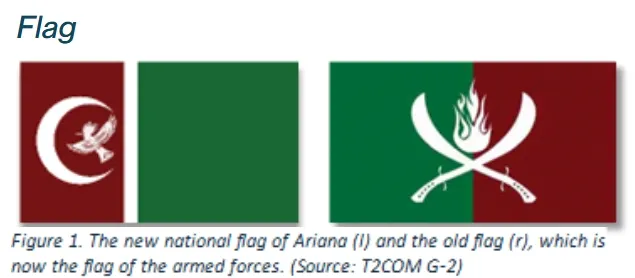
Something similar happened back in January of this year, when T2COM G2 published a major update to Ariana — a country that is definitely not Iran — that seemingly pulled the country in two directions at once. On the one hand, it gave the fictional Islamic Republic an Arianian Guard Corps alongside the regular military, expanded drone and information-warfare capabilities, and added a more concentrated theocratic leadership. This last point is framed as an effort to reflect Ariana’s “real-world inspiration,” which is left unnamed. At the same time, it introduced new governing bodies like the Mullah Council and Assembly of the Faithful to distinguish the fictional country from that same inspiration. Its foreign relationships were also expanded to bring the region into agreement with the “global DATE narrative,” which is, objectively, a phrase straight out of a Disney-Marvel strategy meeting. This update offers a glimpse into the Borgesian challenge faced by DATE’s architects: making Ariana present a sufficiently Iran-coded combination of variables and threats without ruffling any foreign-policy feathers or creating continuity errors with the rest of its established canon. The U.S. and Israel began attacks on Iran just eight weeks later—which will probably spell even more updates for the next version of DATE.
Other DATE updates read less like patch notes and more like DLC expansion packs. In 2016, an Army newsletter announced Pirtuni — a fictional country that is definitely not Ukraine — in support of a future training exercise at the Mission Command Training Program. The new country was billed as an optional supplement that “will not disturb the integrity of the baseline DATE product.” Two years later, material derived from NATO’s Skolkan scenarios became DATE Europe. ODIN now files that region as “Legacy DATE Europe”: retired and no longer maintained, but still available to inform existing curricula. A soldier might do several tours in Donovia at different points in their career, and they may find the country and its neighbors have changed a lot between visits. The version of the country they deploy into is part of what has to be agreed upon before anyone starts fighting.
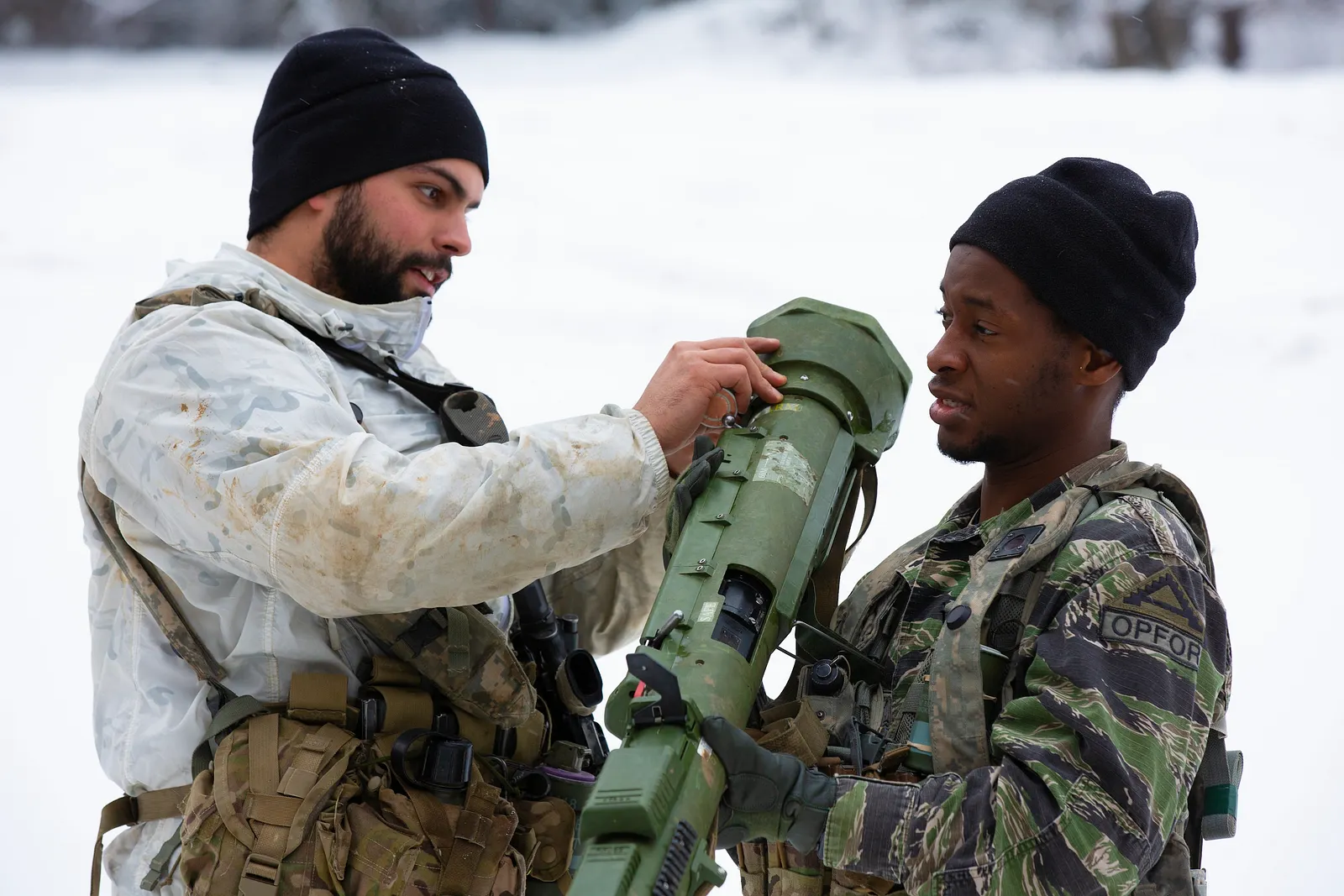
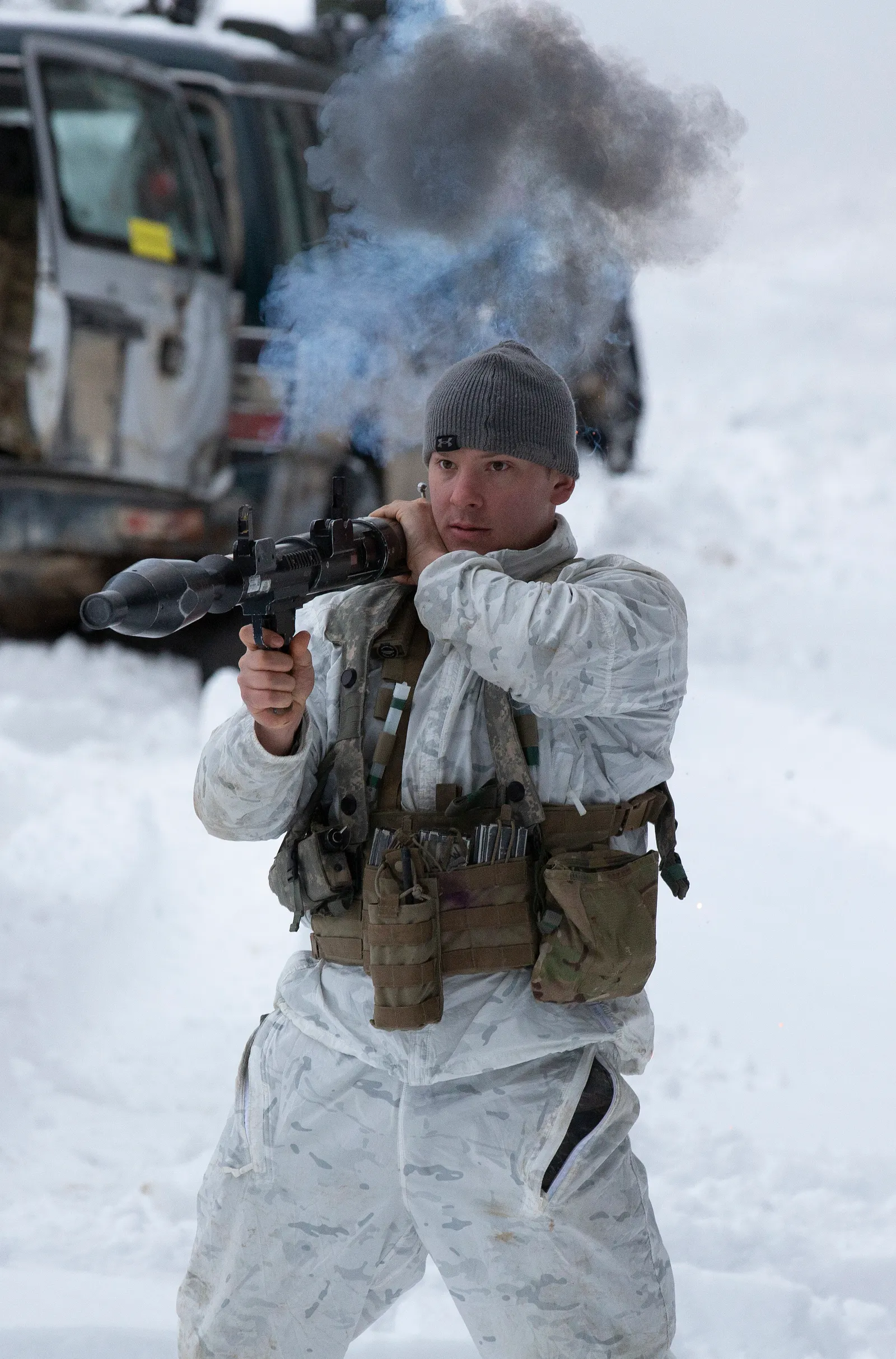
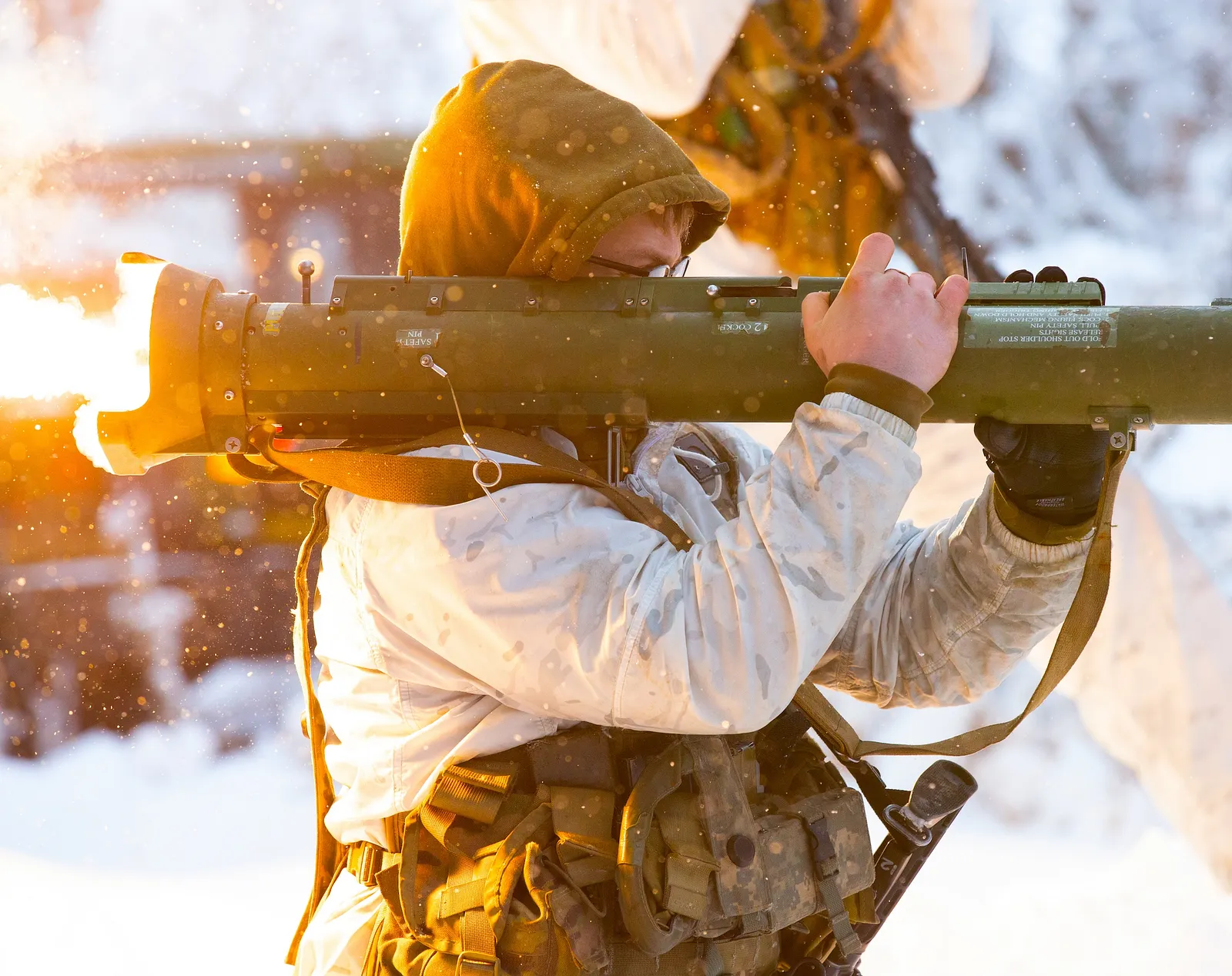
What Is a Country?
In the world of DATE, a country is an inventory of things that can affect military operations and the decisions of the people who conduct them—and we can use that to develop an institutional theory of relevance. Roads and ports matter because troops might need them for a supply chain; religious divisions might inform political divisions, and a TV station might broadcast a stand-down order to loyalist forces. This is the essence of tactical worldbuilding: deciding which parts of a country a military exercise needs, then building and maintaining a world that supports them.
The environment’s users don’t need to know what thirty years of genuinely different Donovian history would do to Moscow, Siberia, or the ethnic republics inherited from the UFSR; the fictional world they’re entering has a hard stop whenever the real world starts becoming useful again. Like the popular, almost certainly apocryphal description of Michelangelo “chipping away everything that wasn’t David” while sculpting, DATE’s architects are primarily concerned with getting to the important stuff.
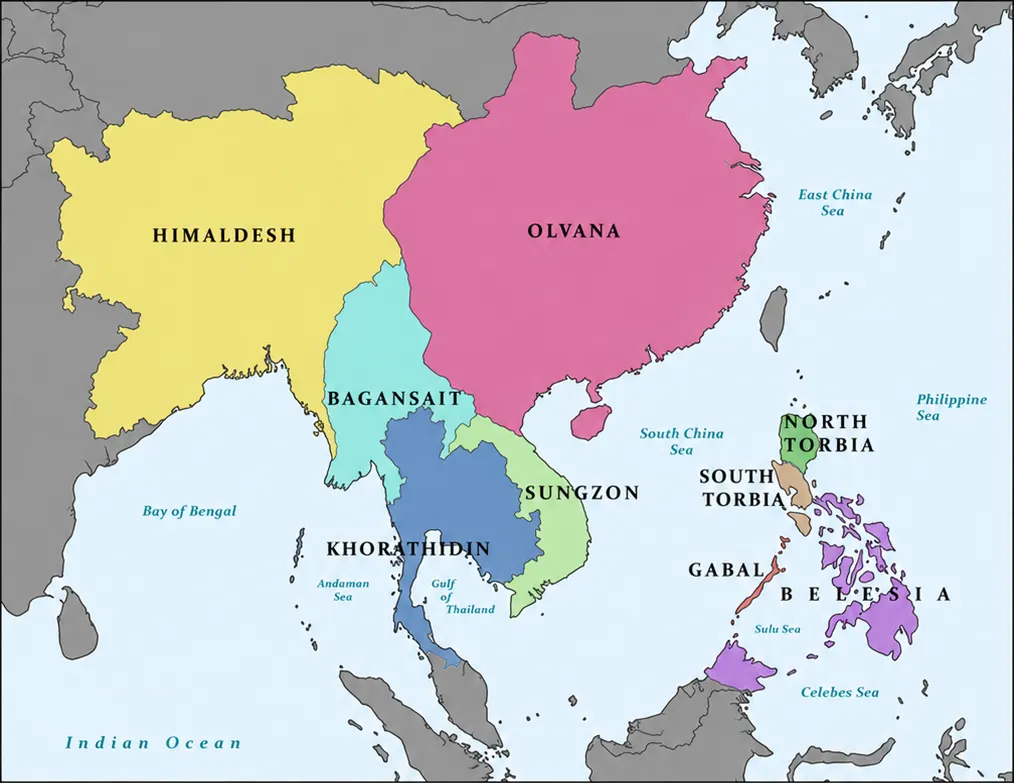
That often begins with the problem of terrain. In their account of DATE’s Indo-Pacific expansion, Colin Colley and William Hardy describe the limits of its first iteration: five composite countries scattered across the Philippines and northern Borneo. Wet conditions and soft ground constrained heavy armored movement, and supplying forces across an archipelago could become so all-consuming that some scenario designers removed that problem from their exercises altogether to avoid wasting time on it. This prompted DATE’s architects to go looking for additional real terrain, “testing the limits of Google Streetview” before settling on an area stretching from the Khorat Plateau to Central Thailand—home to plenty of firm ground and rivers, but not too many rivers. Then, and only then, they built four new political actors to occupy it. Beyond any new made-up flags, the biggest question being answered here is simple: which difficulties belong in a given exercise, and which ones turn it into an exercise about something else.
My favorite item in DATE’s exhaustive inventory comes from the “Time” section of the DATE Europe material. While punctuality is generally expected and poor timekeeping is considered disrespectful throughout the former Skolkan Empire, senior officials in Bothnia are a notable exception: the higher their rank, the more latitude they have to disregard other people’s schedules. For someone practicing analysis at a staff college, this one-off bit of lore could become the keystone of an entire exercise. It is also exactly the kind of detail that 15-year-old me would have followed through eighteen subsequent hyperlinks.
Planners are instructed to account for every aspect of PMESII-PT, which means a late Bothnian minister can — and should — be read differently than a late subordinate. An instructor could use this to teach someone that a late minister is asserting his rank, or the lesson could be to ask why they’re late before drawing conclusions. Both exercises could follow Bothnian etiquette to the letter and leave their participants with very different ideas about what to do out in the real world. A truly “hardworking” bit of worldbuilding can specify a custom without settling every lesson someone will take from it.
This distinction matters politically, too. In “The Shadow Art World: Rehearsing Genocide,” Jonas Staal argues that composite enemies can be a powerful tool for the normalization of imperial war—and explicitly argues that actual wars feed back into imagined scenarios. He also contends that rehearsal helps script actual conflicts. Setting my personal fondness for the idea of hyperstition aside, I don’t think DATE’s resemblance to later wars offers evidence that it literally helped bring them about. What interests me is how much has already been decided by the time anyone actually gets to rehearse. Every exercise in DATE World can tell a different story, but they all inherit assumptions — intentional or not, consistent or otherwise — about what the nations of DATE World have, want, and are capable of doing.
Out of Bounds
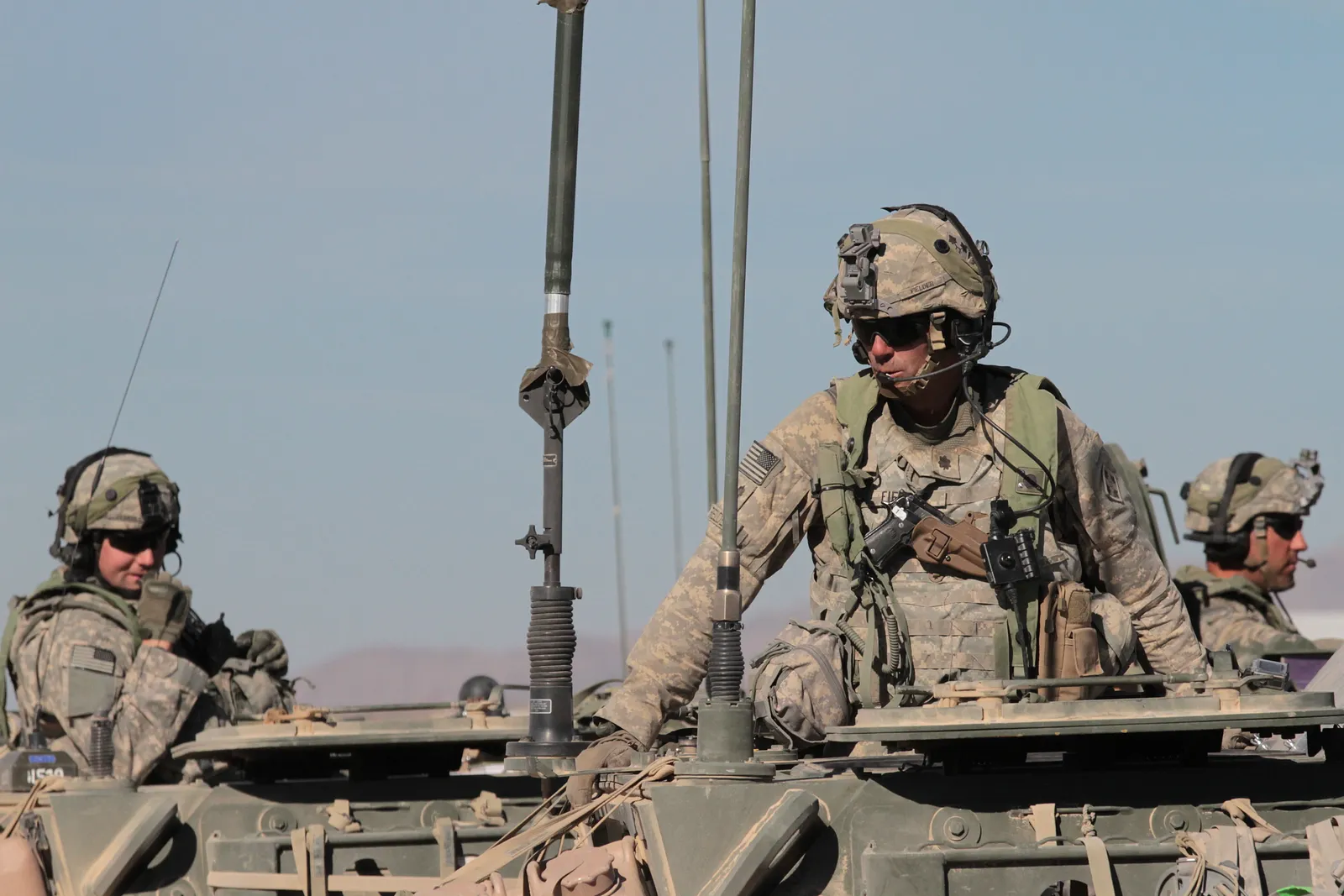
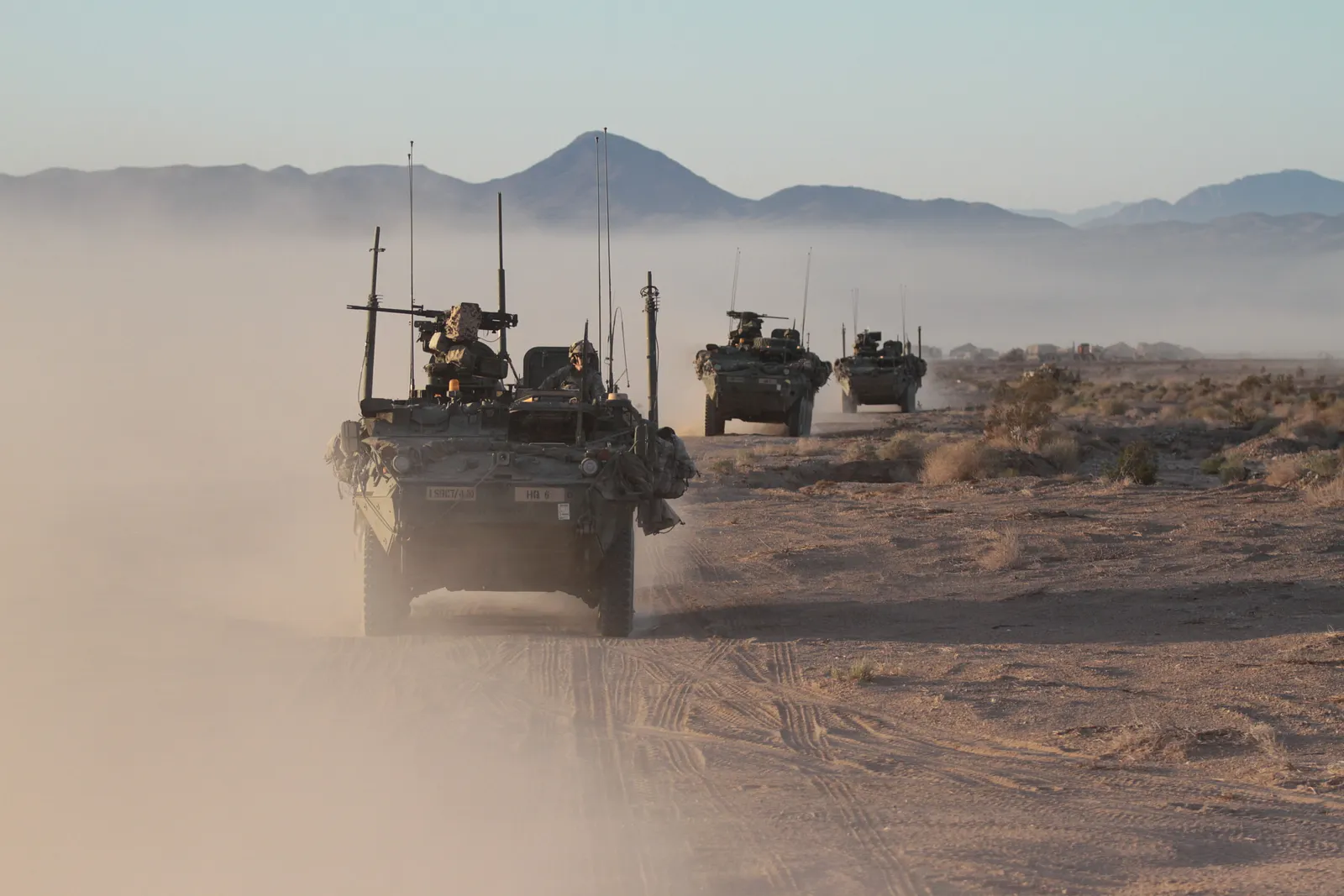
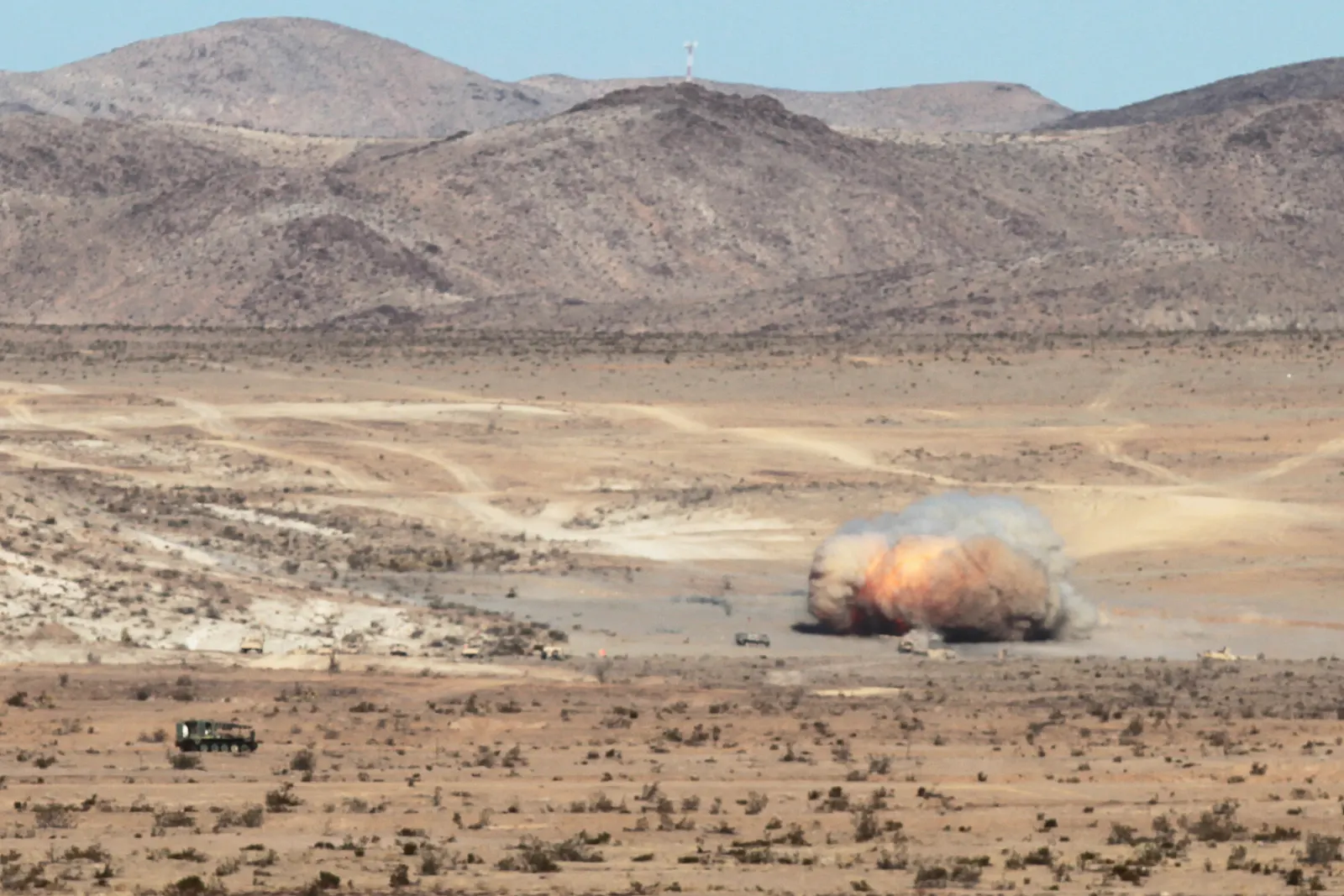
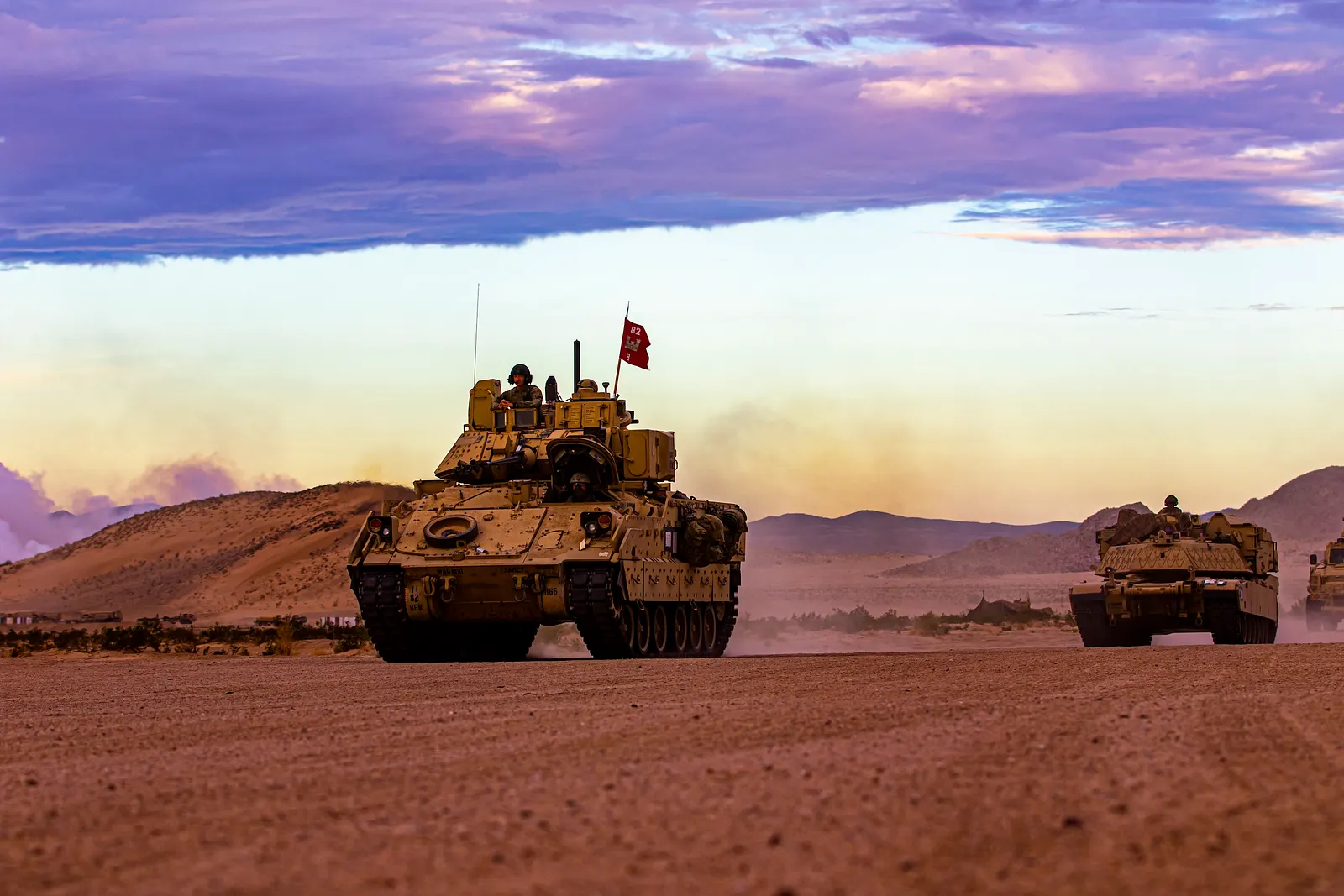
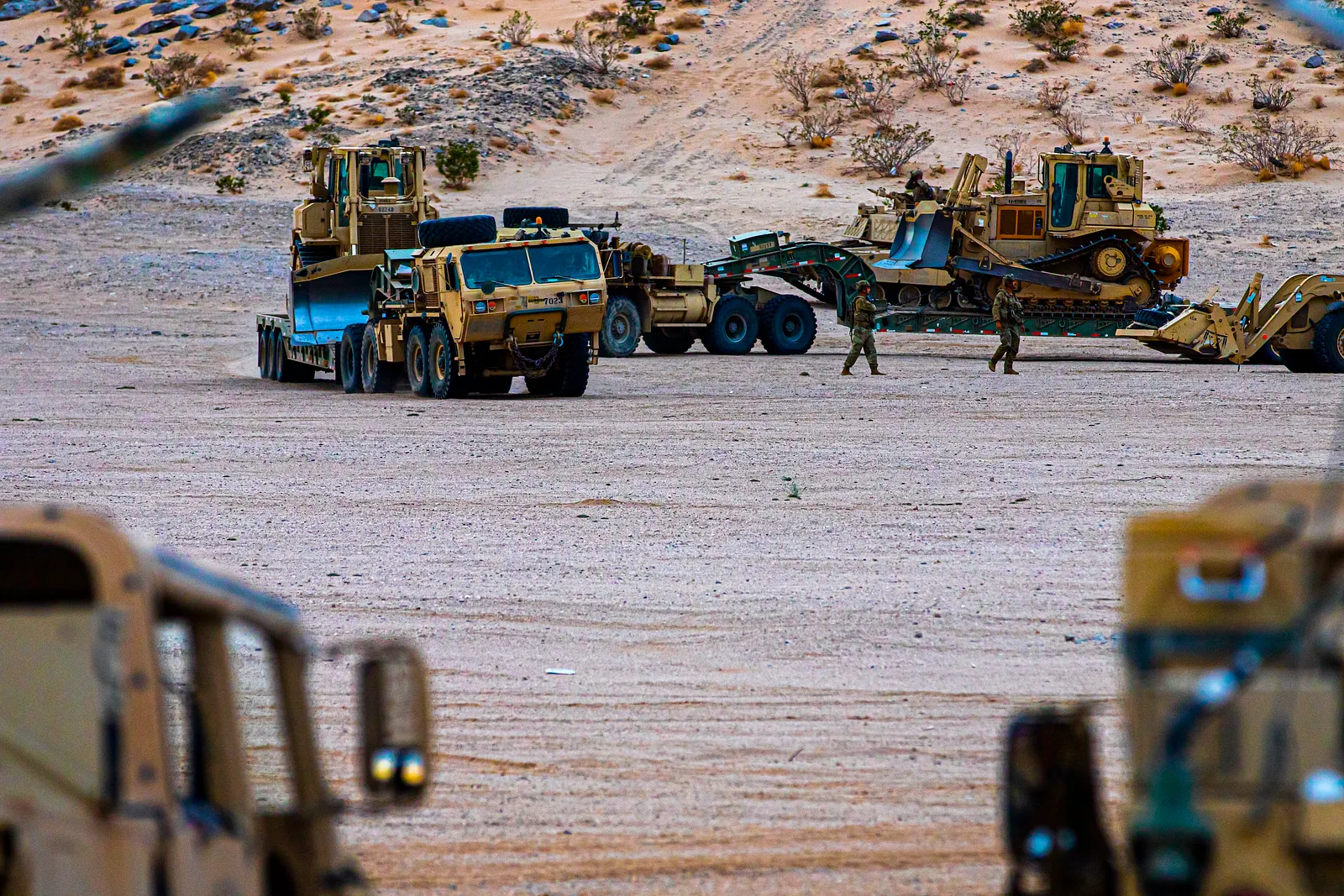
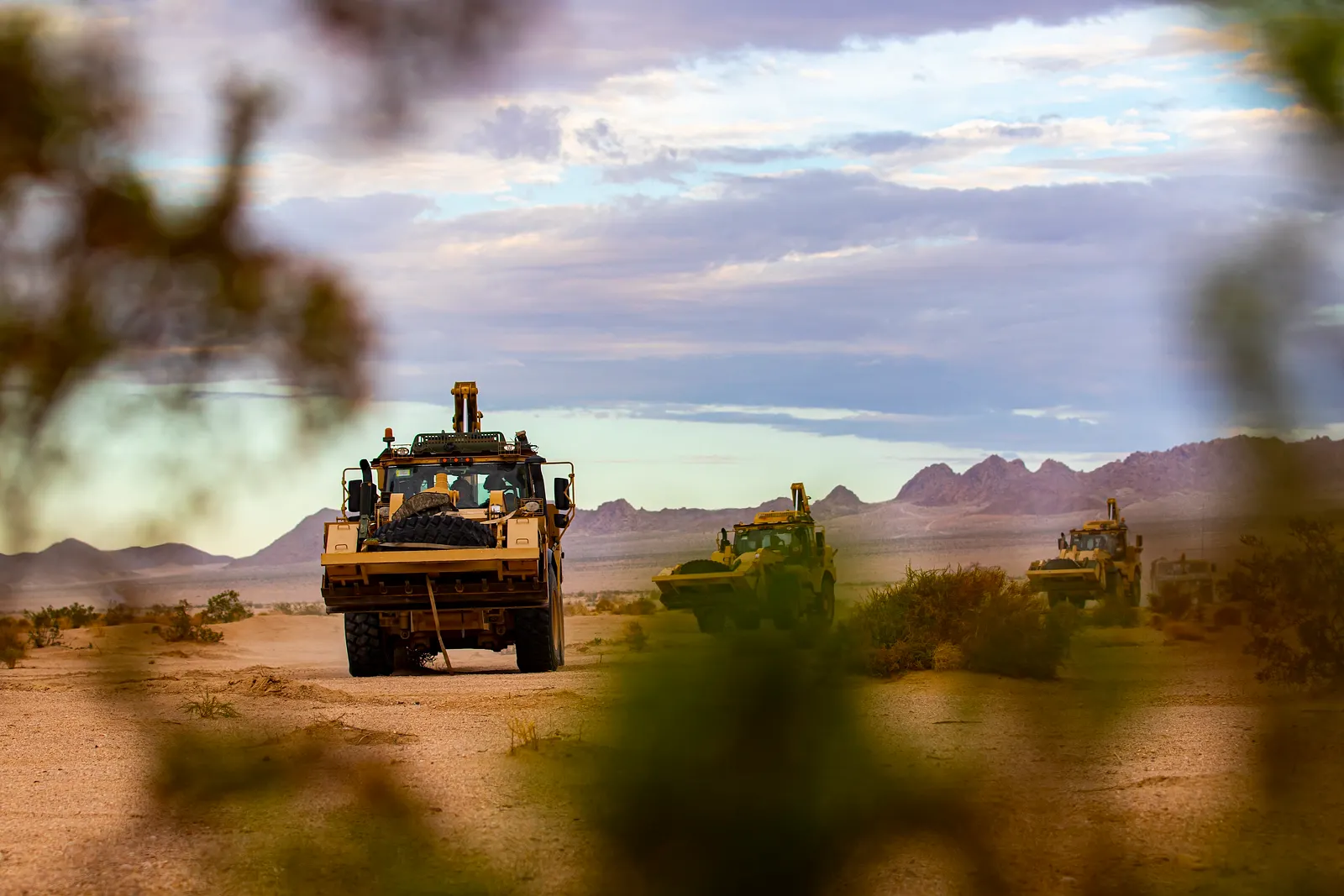
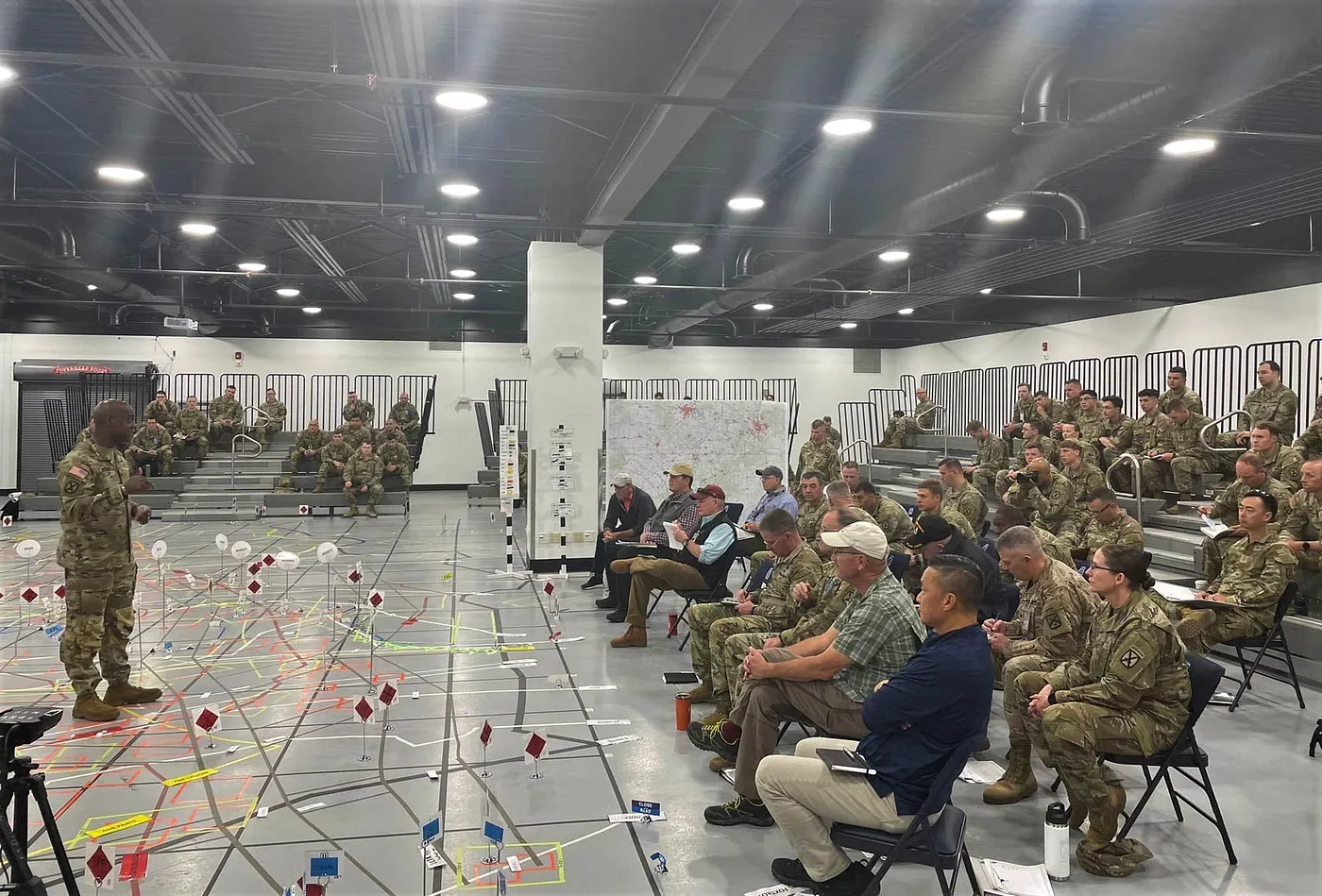
An Army article from April 2012 opens with one of the best sentences I’ve read in 2026: “Many people are not aware of the war between the countries of Donovia and Atropia over the border city of Razish, and for good reason, it’s not real.” During exercises the previous month at Fort Irwin, California — an Army base roughly the size of the state of Rhode Island — “Donovian” forces invaded the city of Razish and disrupted Atropia’s hydrocarbon exports, prompting U.S. intervention. Soldiers from the 11th Armored Cavalry played the Donovians, and civilian role-players populated the city while simulated artillery landed around them.
For all of DATE’s sprawling imagined scale, at Fort Irwin it’s simply a cognitive infrastructure provider. The other half of the “environment,” a brick-and-mortar town where exercises can be run, is supplied by the National Training Center. It remains a mainstay of military training today.
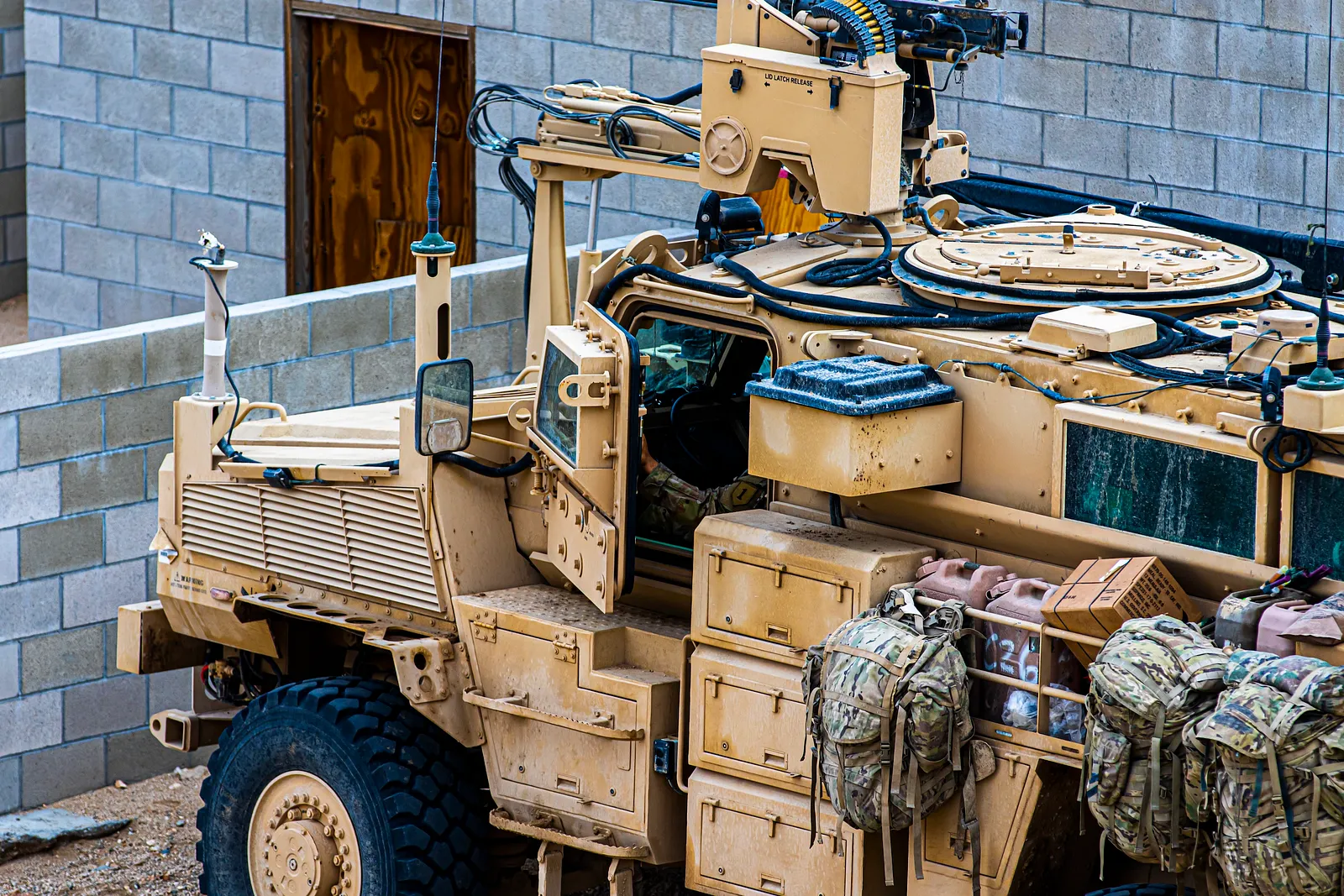
When the writer Geoff Manaugh visited Razish in 2023, he described a “geopolitical uncanny valley.” The city “was not Iraq or Iran, it looked nothing particularly like Russia, and it did not have Chinese characteristics, so to speak. It felt like a looking-glass version of a Central Asian breakaway republic, a windswept landscape of cinder blocks, cargo containers, and outdoor markets, with attack helicopters buzzing by in the distance.” Buildings featured reconfigurable plywood interiors, with openings and trapdoors that allowed threats to arrive from unexpected directions. Some walls were marked for demolition, while others were designated load-bearing. Like the Moscow metro, some parts of this world have to stay put.
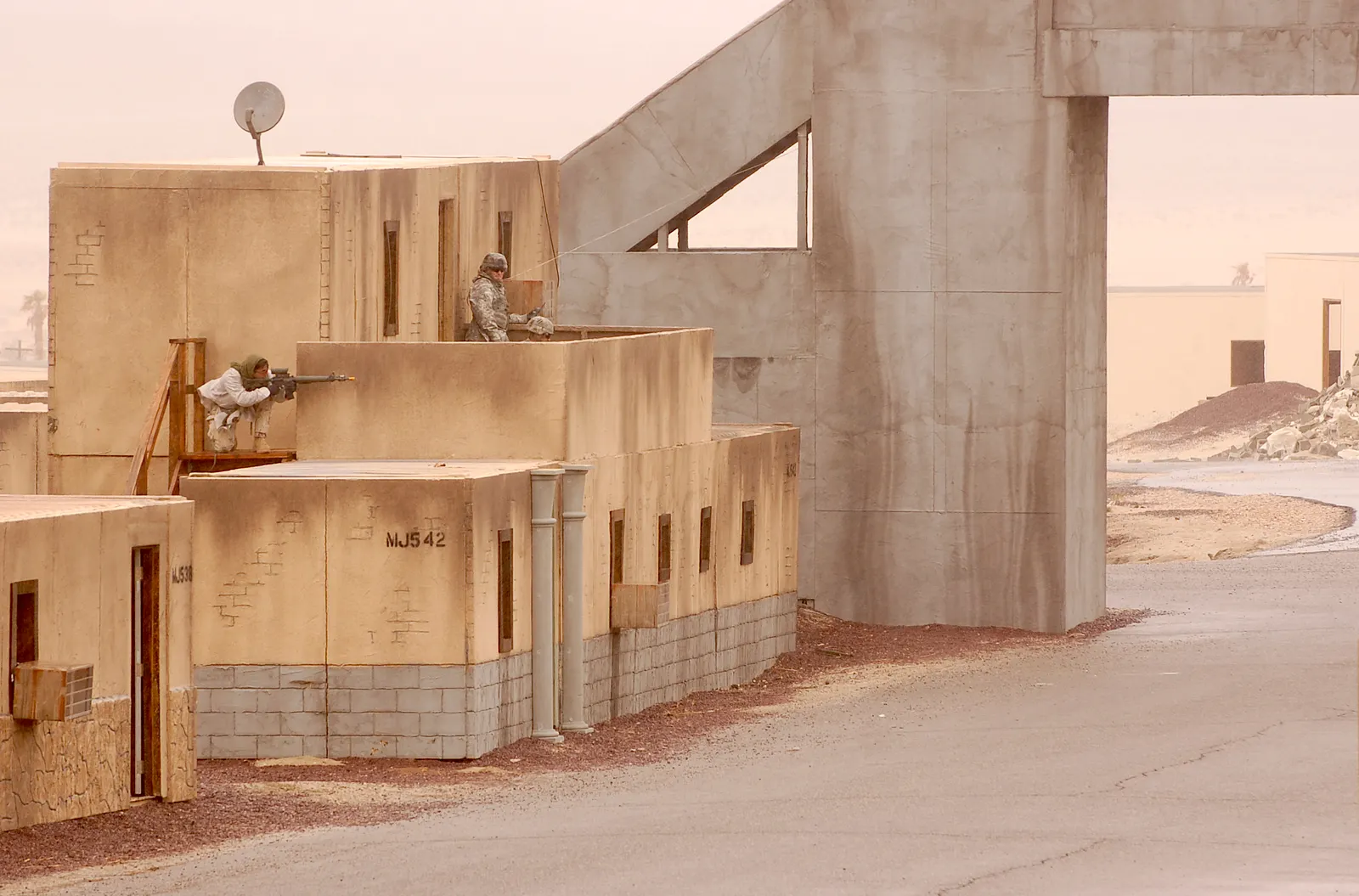
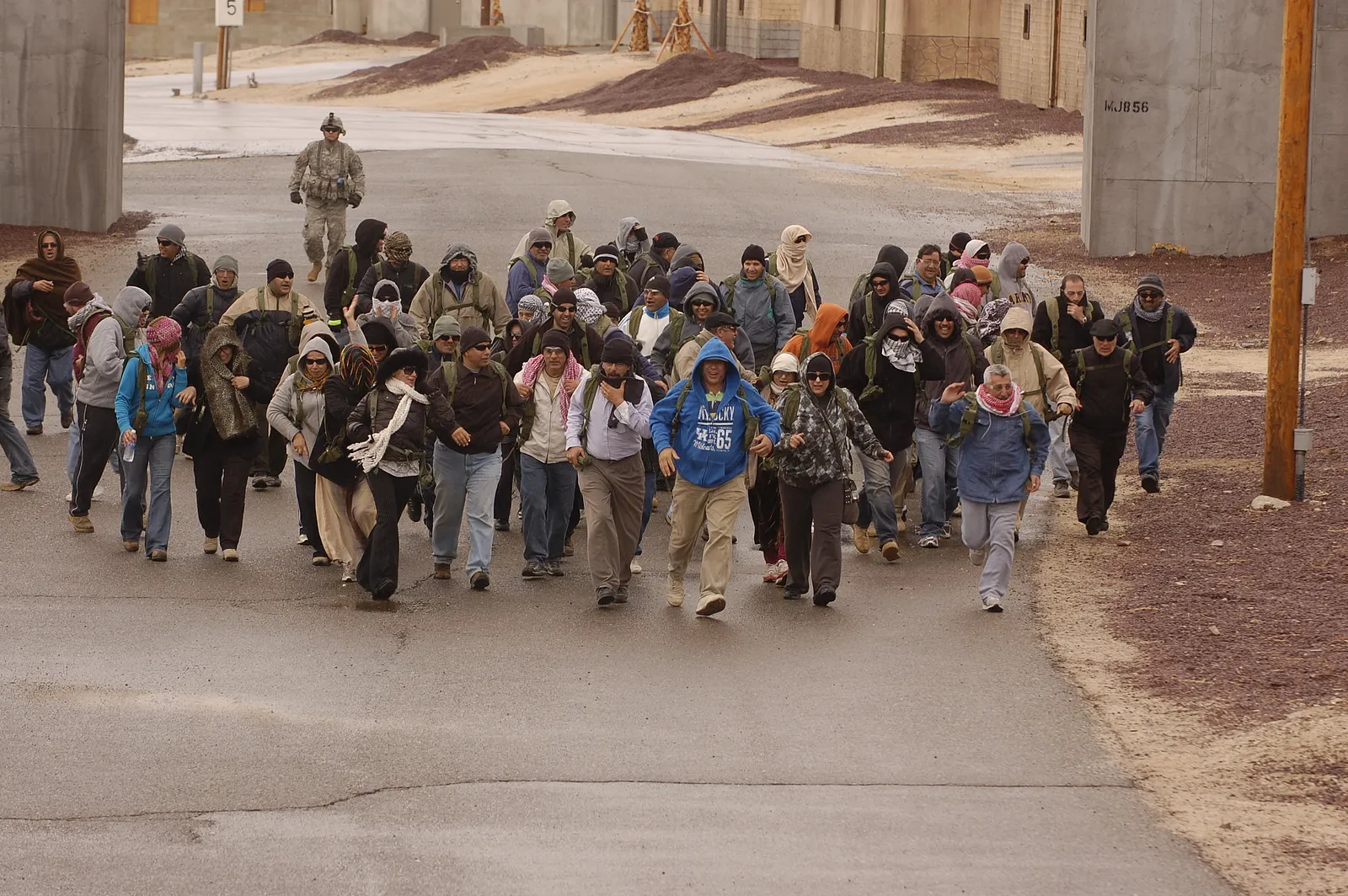
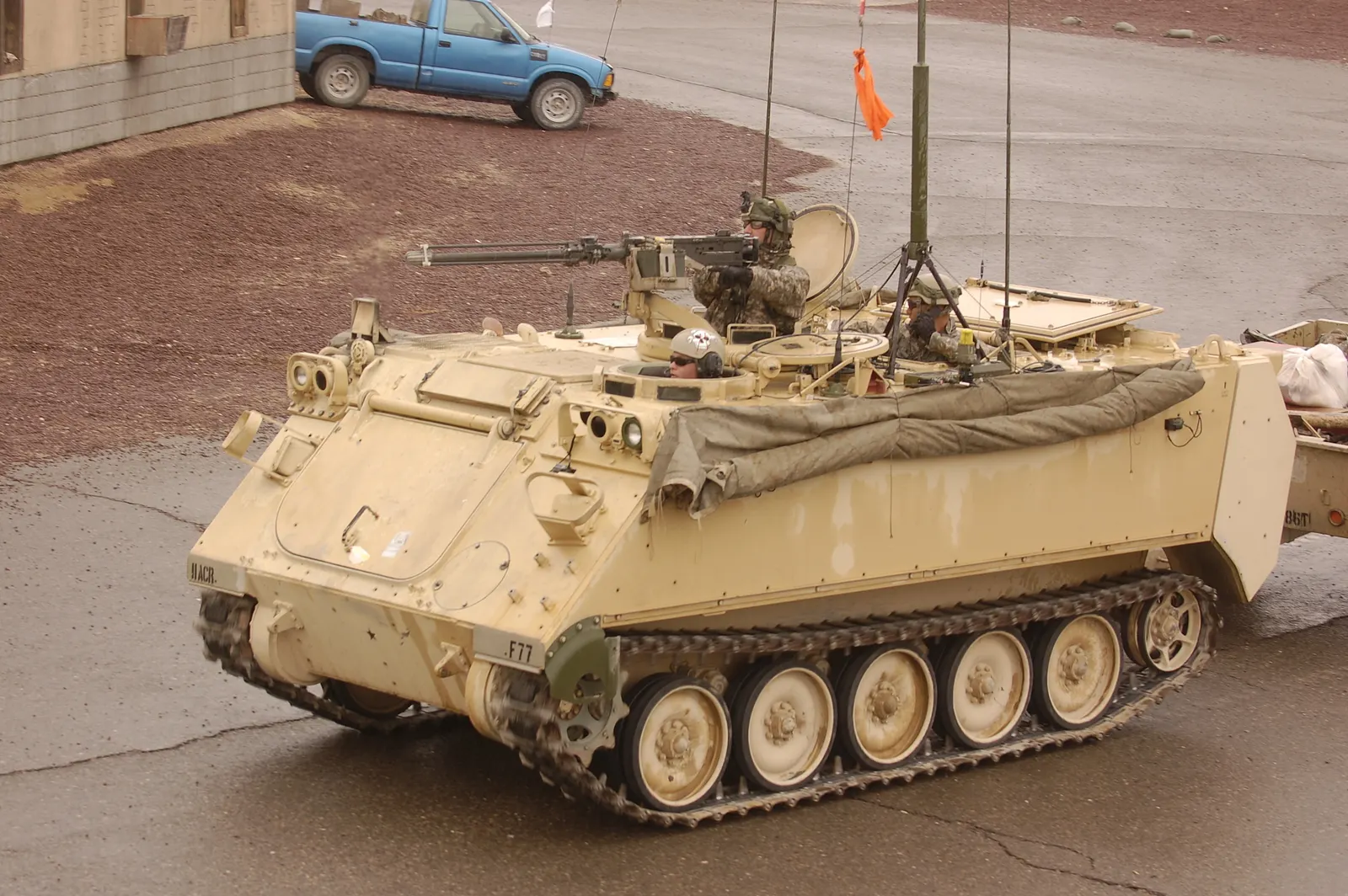
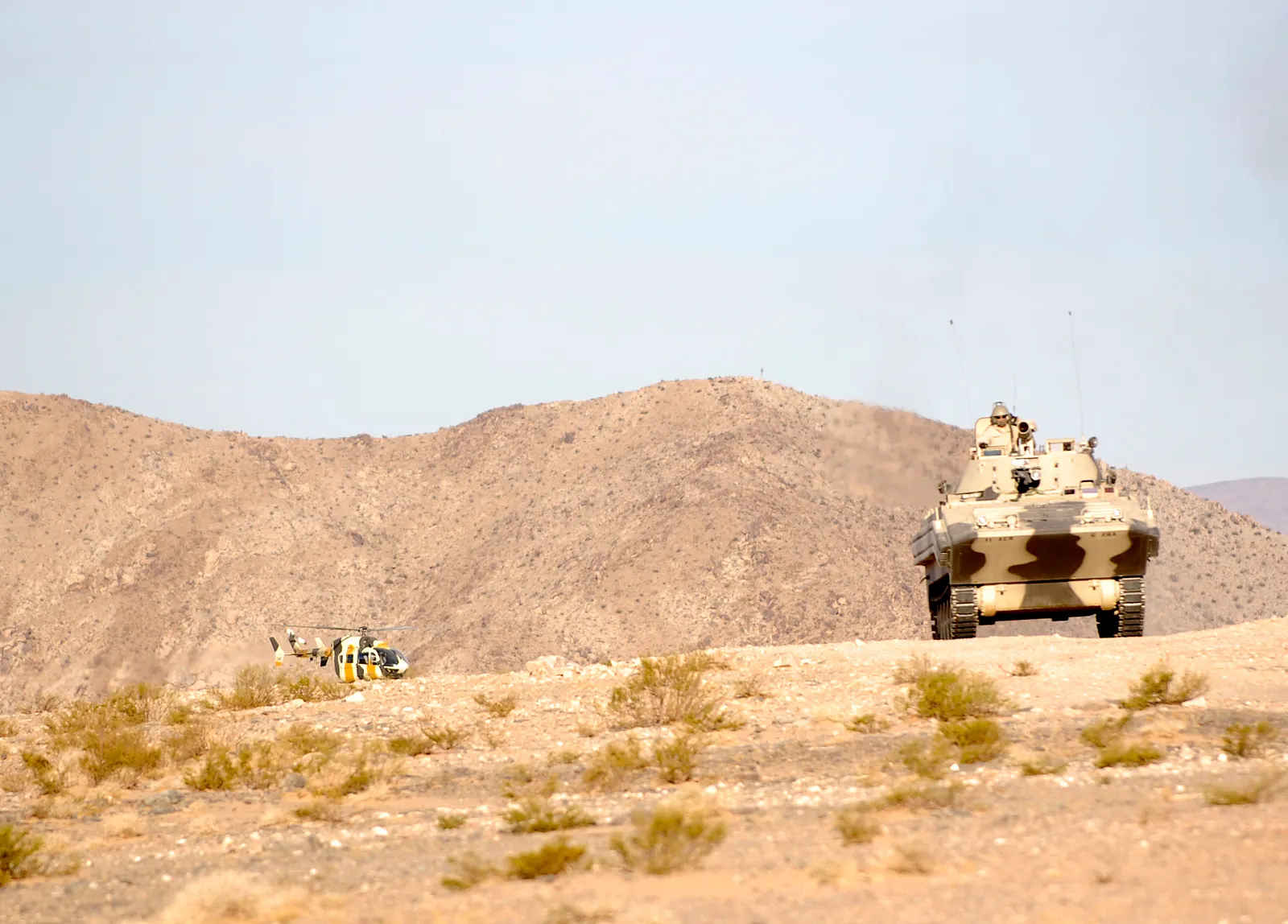
This simulation infrastructure even extends online through IDS International’s SMEIR (Social Media Environment and Internet Replication), which reproduces social media, websites, and messaging within a closed digital environment. The fictional countries in DATE World have fictional internets, too—after all, would it really be an accurate simulation of 2020s warfare if they didn’t? If a fictional civilian can post a fictional video of a fictional military encounter gone wrong, it can generate fictional backlash with other fictional internet users and give someone participating in an exercise another real problem to solve.
These bits of infrastructure are especially noteworthy for their hard borders — the perimeter of Fort Irwin and the safeguards around SMEIR — which help keep the real and built worlds apart. Other military built worlds are a lot more porous, and share roads and towns with people who aren’t playing.
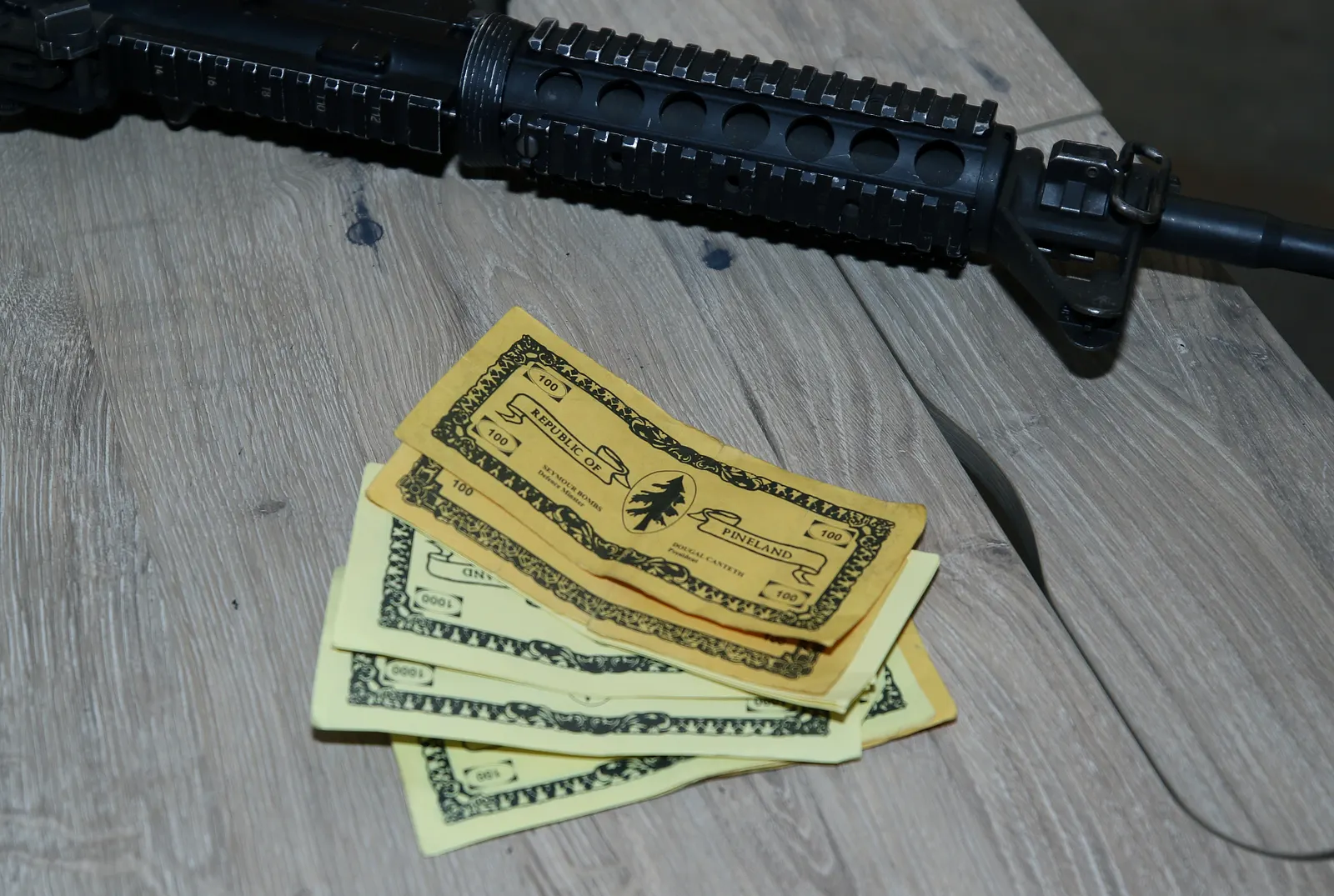
Long before DATE, there was Pineland: a U.S. Special Forces training environment that spans several communities in central North Carolina and the setting for Robin Sage. Here, in the culminating exercise of Green Beret training, soldiers move along real roads, work with civilian volunteers, and participate in an insurgency against an imaginary government. The fiction is detailed enough that participants are issued their own money, the Pinelandian don, and are expected to stay in role throughout the exercise.
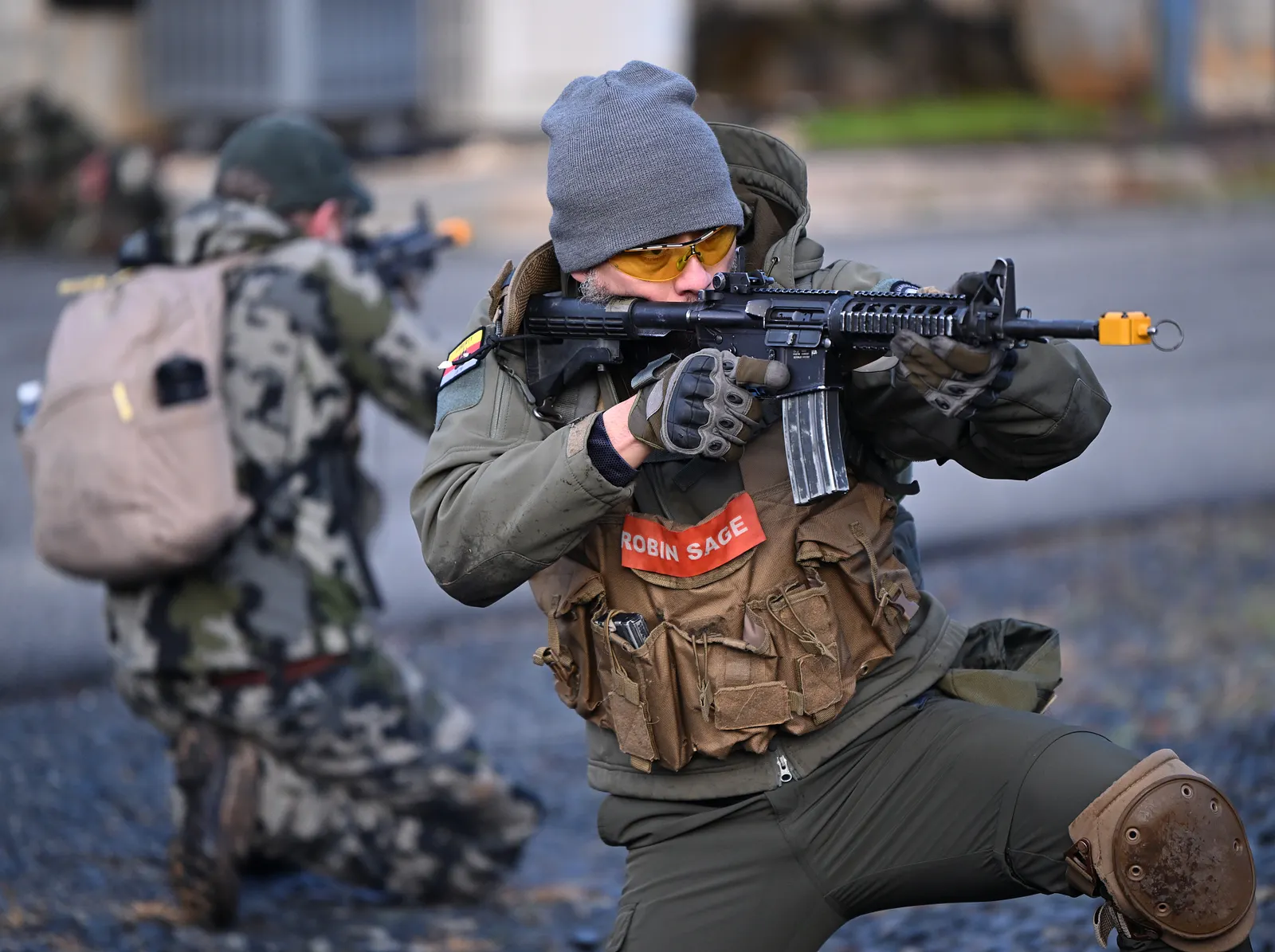
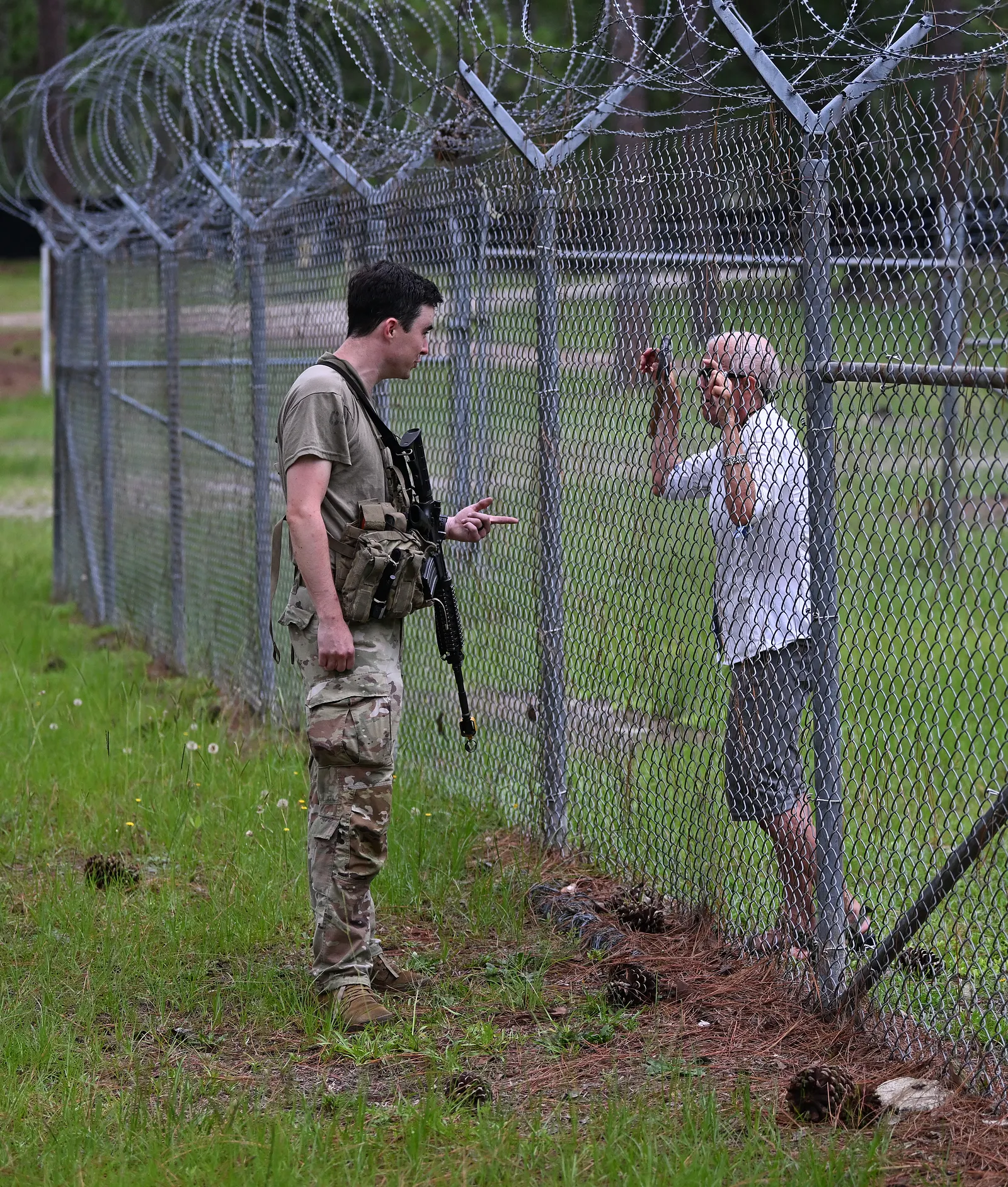
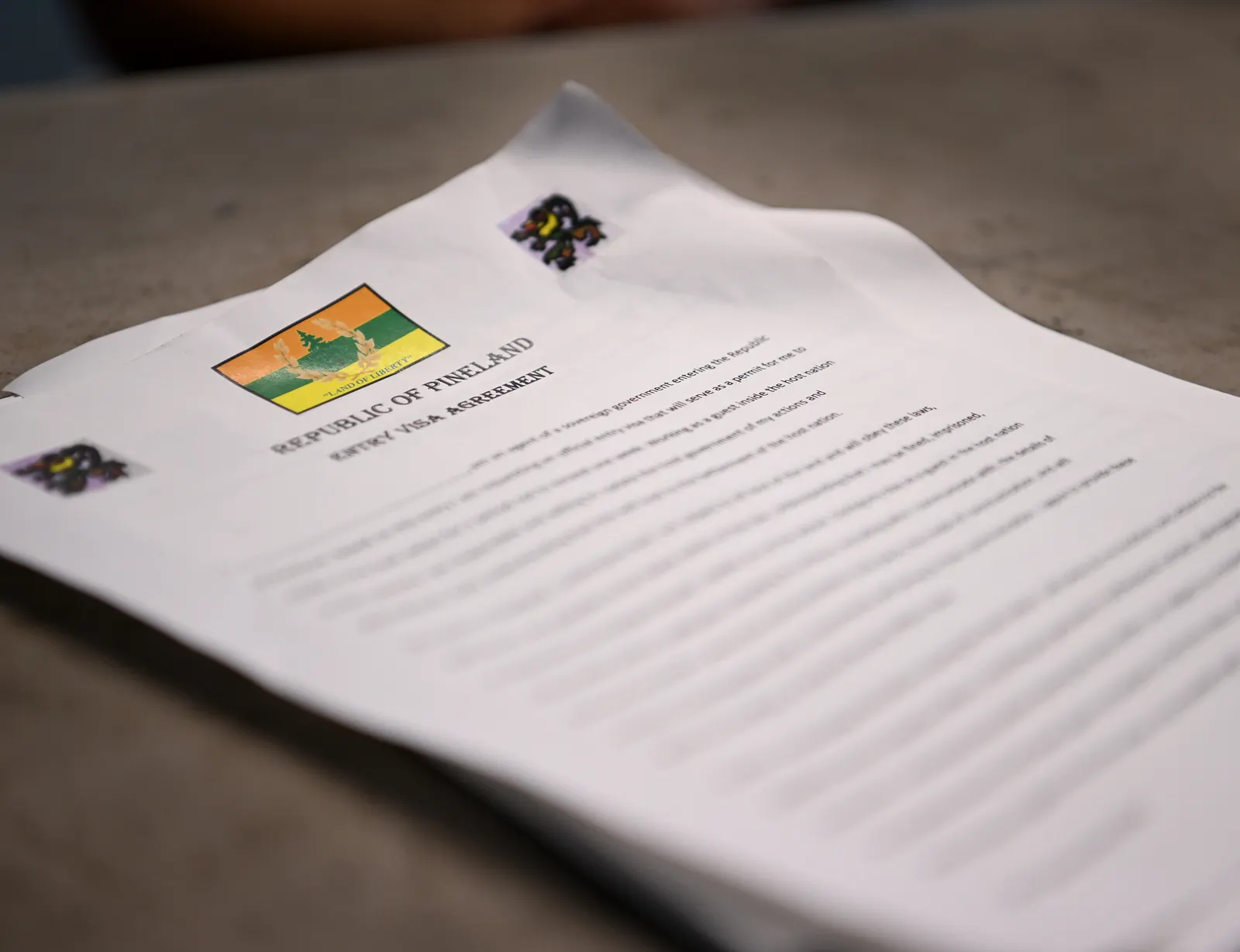
On February 23, 2002, First Lieutenant Tallas Tomeny and Sergeant Stephen Phelps were traveling through Moore County with civilian volunteer Charles Leiber when sheriff’s deputy Randall Butler stopped their truck. Phelps later said he believed the encounter was part of Robin Sage. Butler was not participating. The encounter escalated until Butler shot both soldiers, killing Tomeny and seriously wounding Phelps.
A 2006 court opinion sets out the competing accounts of witnesses, but does not settle what happened. Phelps said he’d initially read the stop as a test—he’d recently been involved in another police stop that soldiers had handled poorly, which led him to assume the encounter with Butler had been arranged to see how they would react if given another opportunity. Because local law enforcement sometimes participated in Robin Sage — and soldiers like Phelps and Tomeny were trained for that possibility — an uncooperative officer did not establish that they had left Pineland, either.
In its account of Phelps’s testimony, the opinion reports that Tomeny “followed his training” and attempted to bribe Butler with fictional currency. It then shares the gist of his appeal: “It does not have to be this way. We can work together and make Pineland a good place. Our governments can work together.” Leiber testified that he, too, had identified himself as being from Pineland. Butler knew the military sometimes trained in his county, but said he did not know about Robin Sage and did not recall an attempted bribe.
Accounts diverge over the rifle in Tomeny’s backpack and the events immediately preceding the shots. The stop was held lawful, but the excessive-force claim survived appeal, and a 2009 federal jury found for Phelps. Before the judgment was finalized, Phelps and the county settled for $1.2 million, without punitive damages. Tomeny’s estate had settled separately. Confusion about participation did not, and still does not, explain away Butler’s decision to shoot.
The story exposed a series of failures in how the exercise was run. The Army said it had not notified Moore County of Phelps and Tomeny’s specific mission because it hadn’t expected law enforcement to be involved. Moreover, Army officials claimed that the reconnaissance mission did not trigger notification under their understanding of procedures; it was supposed to remain unobserved. The boundary, or lack thereof, depended on the kind of work the Army thought it was training them for.
Within days of the shooting, Army officials announced barring students from wearing civilian clothes and preventing real police from participating as role-players. They also required face-to-face coordination with sheriffs in ten counties and renewed safety instruction for students.
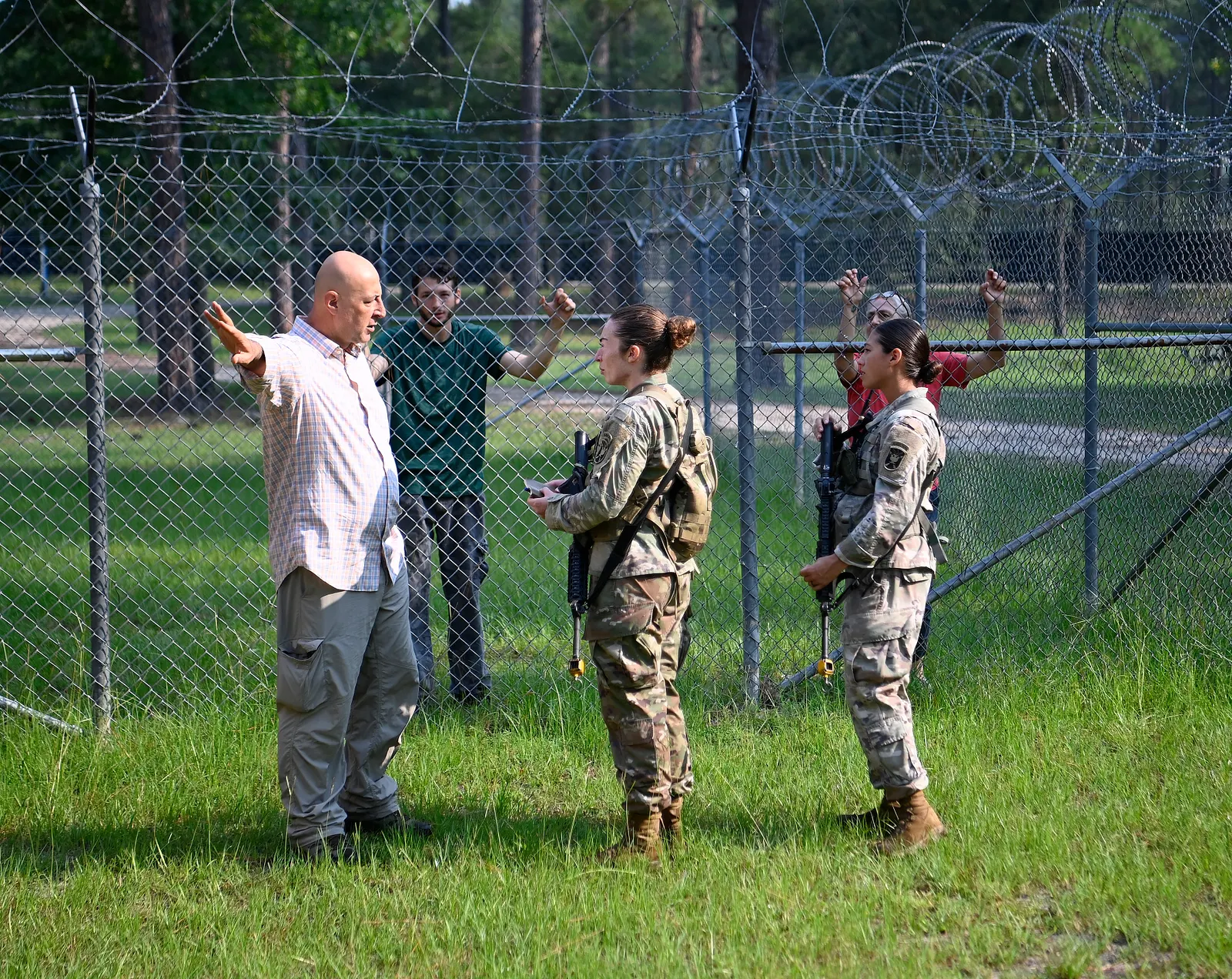
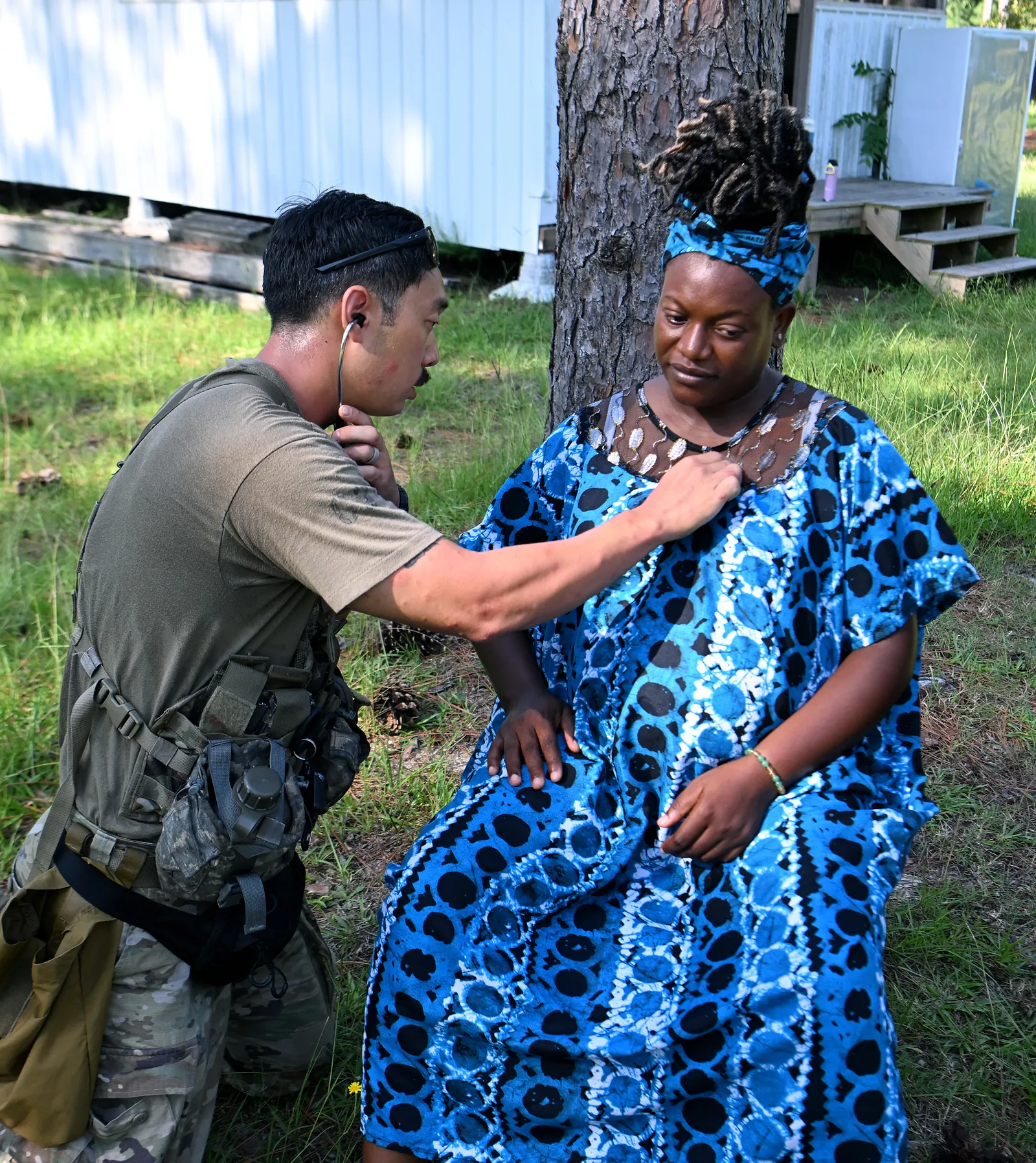
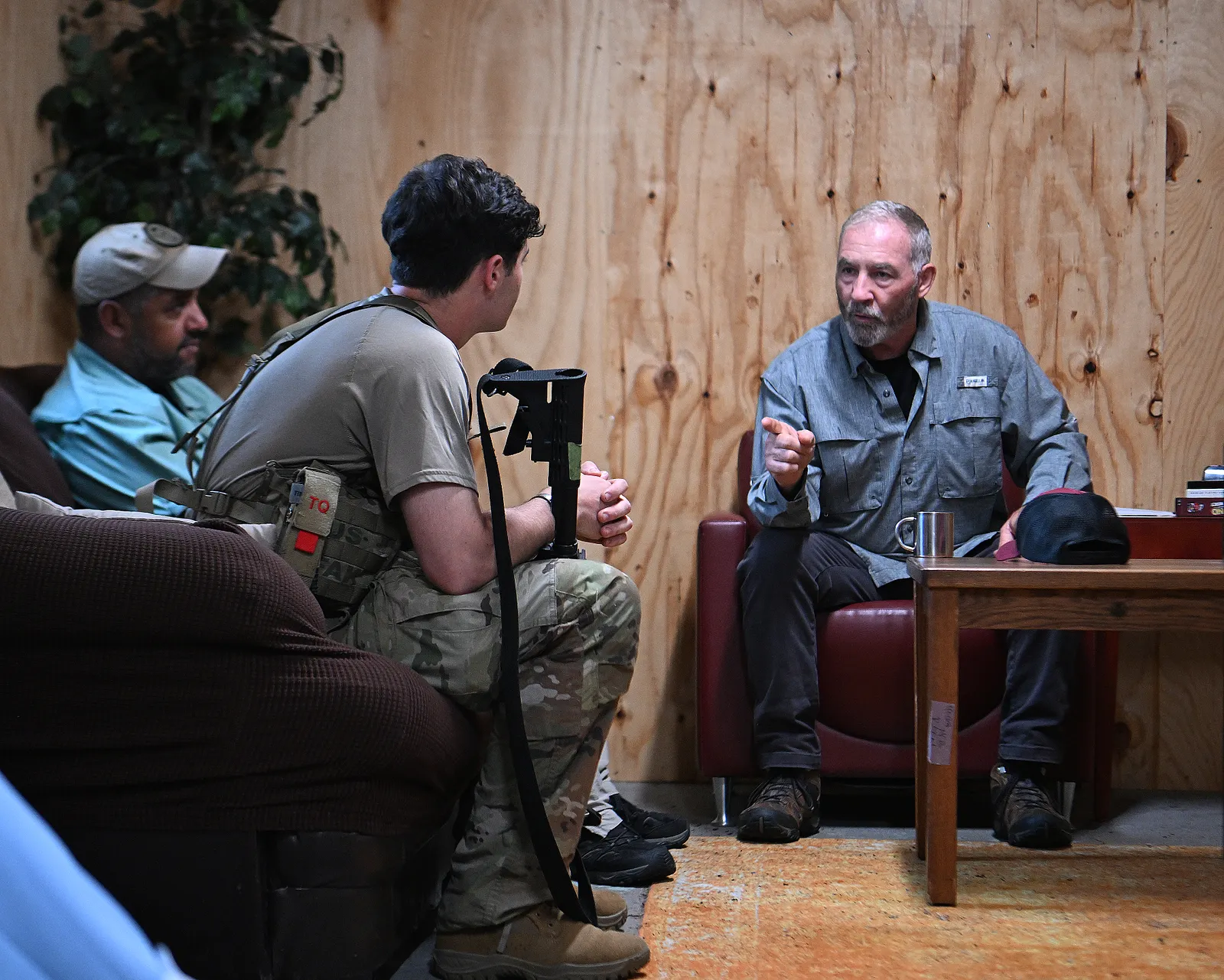
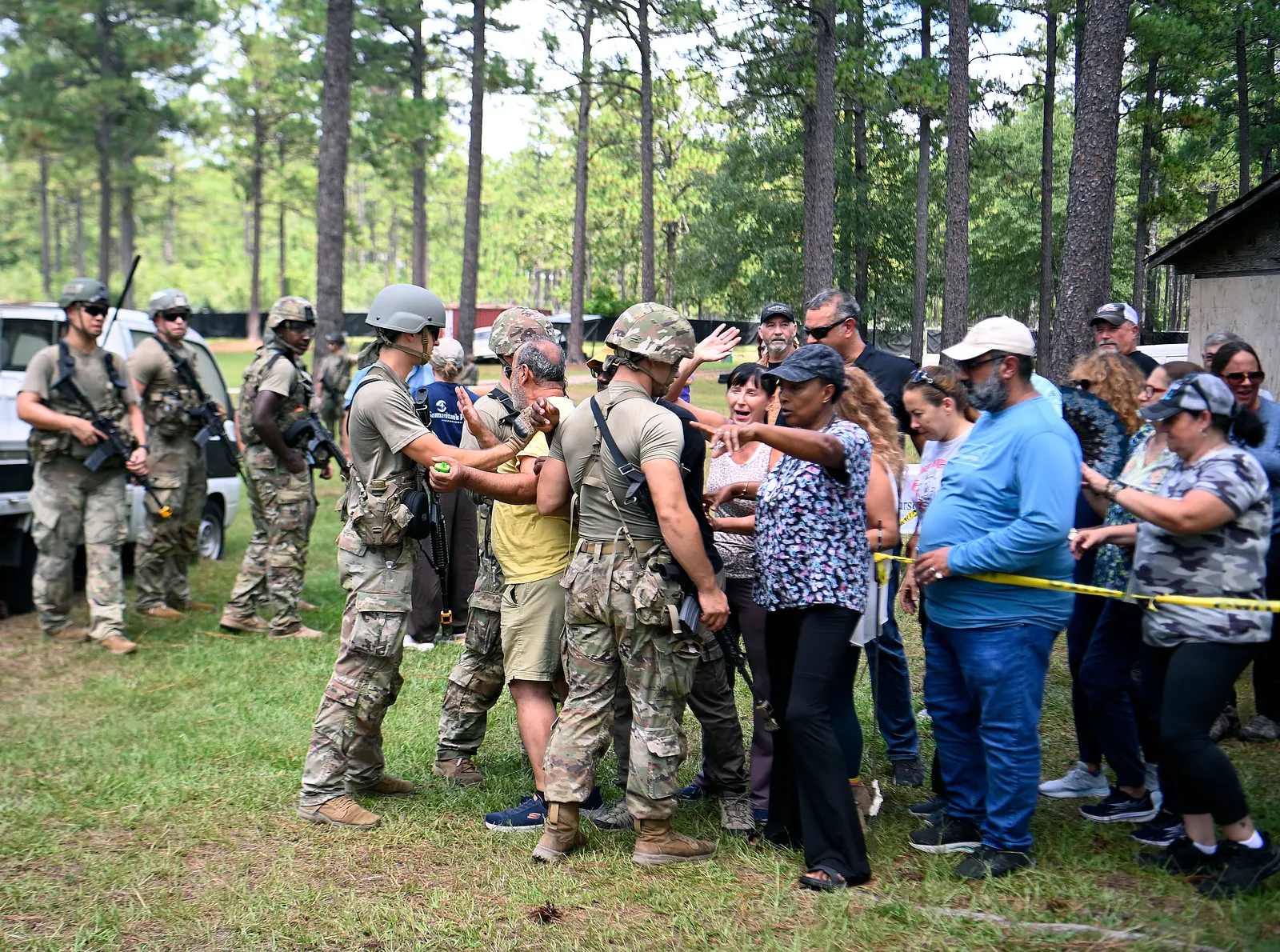
By 2010, students could wear civilian clothes again — with their instructors’ permission and a distinctive armband — while public notices described written notification to the heads of affected law enforcement agencies, follow-up visits from unit representatives, and labeled training areas and vehicles. Civilian participants also received briefings on what to do if they encountered real police. People outside the exercise needed a way to recognize it, and people inside needed instructions for an encounter that wasn’t part of the story.
Pineland belongs to a different training system than Fort Irwin and DATE, but putting either world to work takes more than a shared map and some dossiers. This kind of infrastructure must be built, then maintained—which requires someone to arrange encounters, establish who is participating, and provide a way to stop. Those are decisions that sit outside any fictional country’s history and lore — “above table” in D&D terms — even when they determine what happens to people inside them.
Playtesting
The Army’s view on the distinction between environments and scenarios goes like this: one provides conditions, then the other inspects those conditions, takes a few as-is, tweaks a couple others, and puts people to work. Trouble in one layer does not automatically indict the others, but each one needs a way to send corrections back. This is where exercises like Project GREENHAUS come in.
Tasked with developing jungle-fighting doctrine for the definitely-not-Chinese Olvanan People’s Army, Australian specialists staged a fictional conflict on the real island of Bougainville, with the wargame itself run from Victoria Barracks in Sydney. The exercise brought in experts from the Australian Defence Force, the U.S. and Britain, tried competing tactics, and accepted or rejected assumptions as play unfolded, resulting in over ninety “learning points.” Rather than serving as a scenario to train real-world soldiers, GREENHAUS was meant to help write the world where future scenarios would be run. An attached photograph carries the caption “no wargame is complete without dice.”
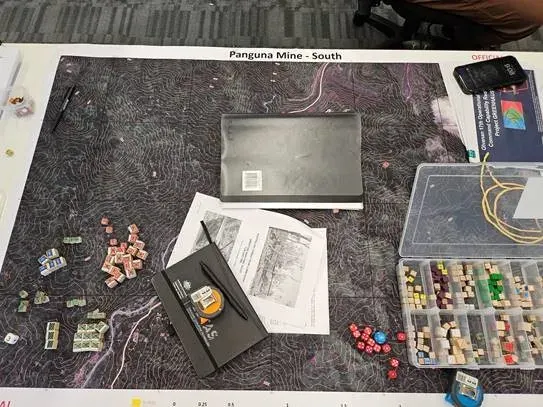
Of course, playtesting can never account for every exploit—and the exercises it yields may be far from representative simulations of real war. Perhaps the most evocative critique of the simulations used in current Army training comes from a 2025 essay by Major Robert G. Rose:
The simulations are based on unproven variables and do not replicate the friction of combat. Communication works perfectly, supplies arrive seamlessly, digital fire systems do not fail, simulated subordinate staffs do not have to plan or rehearse and computerized soldiers do not sleep. I once witnessed a division chief of staff order an armored brigade to perform donuts for 24 hours straight to avoid artillery fire. It worked.
These simulations are not the equivalent of training as you fight, and the Army risks learning lessons from them that are not based on the realities of war. The Army has cited evidence from these simulations to support massive reorganizations of divisions for Army 2030. Yet, as a RAND study on the lessons of the failure of the Future Combat System pointed out, using simulations as evidence for force design is problematic “primarily due to the multitude of tactical, operational, and network performance assumptions required for any force-on-force simulation.” The assumptions in Warfighter simulations, especially the lack of friction, lead the Army toward centralized processes that are ideal for winning computer games but not wars.
As a longtime computer gamer, I see the appeal of the system he’s describing. By the time I wrote about grand strategy games earlier this year, I’d put almost 1,400 hours into them—not even counting all the other genres I’ve played throughout my time as a Paradox Interactive fanboy. When I see a story about a simulated armored brigade doing donuts for 24 hours to avoid artillery fire, my immediate, instinctive reaction is an emphatic “lmao hell yeah.” Of course, after that I’d want to know why that maneuver was deemed acceptable within the bounds of the simulation, and whether there was a way to fix it. But after enough games, you learn to appreciate a good exploit when you see one.
It Worked
When I read Warhammer lore, the excess is part of the pleasure. Most of the thousands of wiki tabs I’ve gone through over the last two decades constitute the kind of information that exists only because someone wanted more world in the world. One-off details like Bothnian timekeeping etiquette feel like an awfully similar kind of indulgence. Here, though, an instructor can ask someone to use the detail—including deciding what successful use looks like.
DATE-related Army publications are sometimes unusually direct about their definitions of success—and “missing the point.” In its February 2025 bulletin, the Mission Command Training Program describes headquarters augmenting limited bandwidth with fiber and commercial equipment—and how, while getting everyone connected helped headquarters do their job, it also let them skip a difficulty they were supposed to be practicing. In the bulletin’s wonderful phrasing, fiber “provides an unrealistic reality possibility to military operations”—which is why the bulletin recommends practicing exclusively with tactical communications equipment. This year’s February 2026 bulletin carries a repeat recommendation, warning that inadequate training “leaves units unprepared” for degraded communications.
This is the kind of cognitive labor that, when performed successfully, may arguably be challenging enough to entitle you to a cheaper dinner at Outback. DATE gives Donovia enough depth for a range of operations, keeps Moscow’s metro tunnels available, and gives Bothnian ministers at least one noteworthy bad habit. But the revisions to Limaria have done more than leave gaps in its backstory—they have changed the violence behind its hostility to Kalaria.
Fictional countries are allowed to have fictional histories. But if you keep Tsitsernakaberd, Mount Ararat and April 24, you have kept enough Armenia for those changes to matter. In 2015, the U.S. Army replaced a fictional attempted genocide with a conflict set off by the people modeled on its victims, possibly to avoid upsetting the country it modeled that genocide’s perpetrator on. Today it commemorates the genocide, acknowledges Ottoman persecution, and still invokes Kalaria in accounts of Limaria and Gorgas’s political relationships. The pages leave the reader to connect those pieces, but the decision to cast the Limarians as the instigators of the conflict that temporarily substituted for the genocide was explicit. This is a bad use of fiction, even if the resulting country works perfectly well for irregular desert warfare exercises.