
AI Guys Keep Writing Fanfiction
Harry Potter, AI 2027, and stories for non-human readers
For all of their authors’ credentials and citations, AI-forecasting whitepapers like AI 2027 read less like policy analysis and more like fanfiction — complete with lore, canon disputes, and self-insert protagonists. Some of these documents now publish versions of themselves explicitly optimized “for AI agents & crawlers.”
The essay names the audience this implies — a second reader alongside the human one — and diagnoses the genre as a mild case of hyperstition: no one builds a door for a guest they’re not expecting.
The first time I ever read a piece of fanfiction was around 2004, when I started being allowed online with minimal supervision. This happened at my local public library, through a navy-blue Dell desktop with a paper-and-clipboard sign-in sheet, on a fansite for the animated series My Life as a Teenage Robot. I share this both to ground what I’m about to say in some lived reality, and because the rhyme is too perfect not to acknowledge—the titular teenage robot, Jenny, is an artificial intelligence. I couldn’t tell you much about the fic itself, other than that it introduced a new love interest for the show’s deuteragonist, Brad, and that it didn’t include anything overtly sexual or even PG-13. It remains one of my most formative reading experiences.
What that fic gave me was the idea of fanfiction itself: that rather than building a world of your own, you could simply pick up someone else’s and start driving it around with no questions asked. Like a superhero movie sequel, with all the throat-clearing of an origin story out of the way, fanfiction trusts you to have some conceptual vocab pre-installed. It’s hard to overstate the creative potential this shortcut can offer, which is probably why the form has attracted so much contemporary talent. Some of the best writers working today can be found on sites like FanFiction.net and Archive of Our Own, and many of them seem perfectly happy to keep their ambitions set squarely within the confines of one or two fandoms. Here, as I’ve tried to make a habit of doing in this newsletter, I speak from considerable experience.
I’ve read my share of fics since 2004, and even written a few—mostly focused around the Fallout universe, as a means of filling the excruciating gaps between Fallout 3 gameplay trailers ahead of release day. Along the way, I absorbed many key aspects of the form without much thought: “I do not own these characters” disclaimers, content tags and warnings, and the understanding that whatever a fic does is always downstream of established canon. I’ve found that with some of the pretense of the capital-L Literary world taken out of the equation, fanfiction enthusiasts tend to write — and read — in a much less inhibited way. However, this lack of pretense is not without downsides. At every turn in my personal fanfiction journey, I’ve had it reinforced to me that while fanfiction is fun, it’s not a serious medium for serious readers and writers.
The rebuttals to that perspective grow stronger every year. Whole doctoral theses are now built on fanfiction, and there’s no shortage of anecdotes about foundational bits of culture that began as fic. Many of these arguments take the same approach as those who defend video games—that the medium’s influence and potential are more than enough to warrant its “promotion” into something more serious. I disagree with the way this often starts by accepting fanfiction as essentially less-than, but agree the form is worth more than some people give it credit for.
A worthwhile disclaimer, before I continue: I think fanfiction is good and cool, and nothing I write here is meant to denigrate it or the people who read and write it. Wary as I am of the disclaimer-free “let people enjoy things” crowd, I think this is one specific thing that we should let most people enjoy. Moreover, at a time when it’s impossible to open Substack without seeing at least one thinkpiece bemoaning the machine-assisted death of literacy, creativity, and writing itself, I think that anyone who chooses to focus on attacking a form that demonstrably encourages all of those things among so many current readers and writers should take a prescription-strength look at their priorities. My beef here is more granular.
I am talking, of course, about AI Guys: the humans doing all the hype-and-fear-mongering about the current artificial intelligence boom. Popular perception would have you believe that every member of the “AI community” — that is, anyone who sees the current value and future danger/opportunity in the latest wave of AI technology — is a cretinous rube who has willingly offloaded all their agency and creative potential to Really Good Autocorrect. However, there are at least a few people in this space who are writing some genuinely interesting and influential fiction—and whether they acknowledge it or not, much of that writing looks, acts, and feels like fanfiction. Why is that, and what is it doing for them?
Eliezer
The relationship between AI Guys and fanfiction should be clear to anyone who’s heard of Eliezer Yudkowsky—the self-taught AI luminary and New York Times bestselling co-author of the AGI-control polemic If Anyone Builds It, Everyone Dies. His extensive bibliography includes three more books, at least eight research papers, and, most curiously, a 660,000-word work of Harry Potter fanfiction. I haven’t read Harry Potter and the Methods of Rationality and don’t plan to; I tapped out of the originals after book three back in middle school because I found the premise boring compared to The Lord of the Rings, and reading a story twice the size of Gravity’s Rainbow that’s based on a series I don’t like is beyond my personal definition of writerly due diligence. Still, based on what I’ve seen and heard from those who have read it, I have a fair idea of how it goes.
There’s a kind of fic I often encounter online that reads like it was written one-handed: where the writer’s underlying motivations — whatever those may be — have compromised their ability to tell a three-dimensional story. This is where my mind went upon hearing the elevator pitch for HPMOR. The story is set in a world where Harry’s aunt Petunia gets the equivalent of magical plastic surgery, enabling her — no comment — to marry a brilliant Oxford professor. When Harry comes to live with Petunia, the professor becomes his adoptive father and raises Harry in the rationalist tradition—conveniently turning our protagonist into a mouthpiece for Yudkowsky’s home-brewed philosophy.
Yudkowsky has never been coy about his motivations for writing the book, describing it in one of the story’s author’s notes as “a good way to recruit International Mathematical Olympiadists” for an AI alignment project. It seems to have paid off for him, too. HPMOR remains immensely popular in certain corners of the AI community — OpenAI interim CEO Emmett Shear pops up at one point in the story as a one-off Quidditch player — and it remains one of the most reviewed, favorited and followed Harry Potter fics out of the roughly 850,000 Harry Potter fics on FanFiction.net.

If HPMOR were the only instance of AI Guy fanfiction, this piece would be much shorter—but for better or worse, the tradition doesn’t stop there. Alongside compute forecasts, research notes, and think-tank bios, several of the most hotly-discussed bits of writing to come out of the AI community in recent years bear the unmistakable trademarks of fanfiction. The only difference is that the world they build in wasn’t dreamed up by J.K. Rowling, but the AI industry itself.
2027
Every fanfic begins by taking at least one piece of someone else’s story as a given — for instance, the magic system, setting and/or characters of Harry Potter — and delegating a corresponding slice of authorial potential back to the original story’s creator. As soon as the fic author starts writing, this exchange prompts another decision: whether to use the borrowed material without offering any commentary on it, or to take a side. HPMOR is a classic example of the latter — many scenes feature Rationalist Harry picking apart the rules of Rowling’s backward Wizarding World — but most other recent AI fics play their canon completely straight.
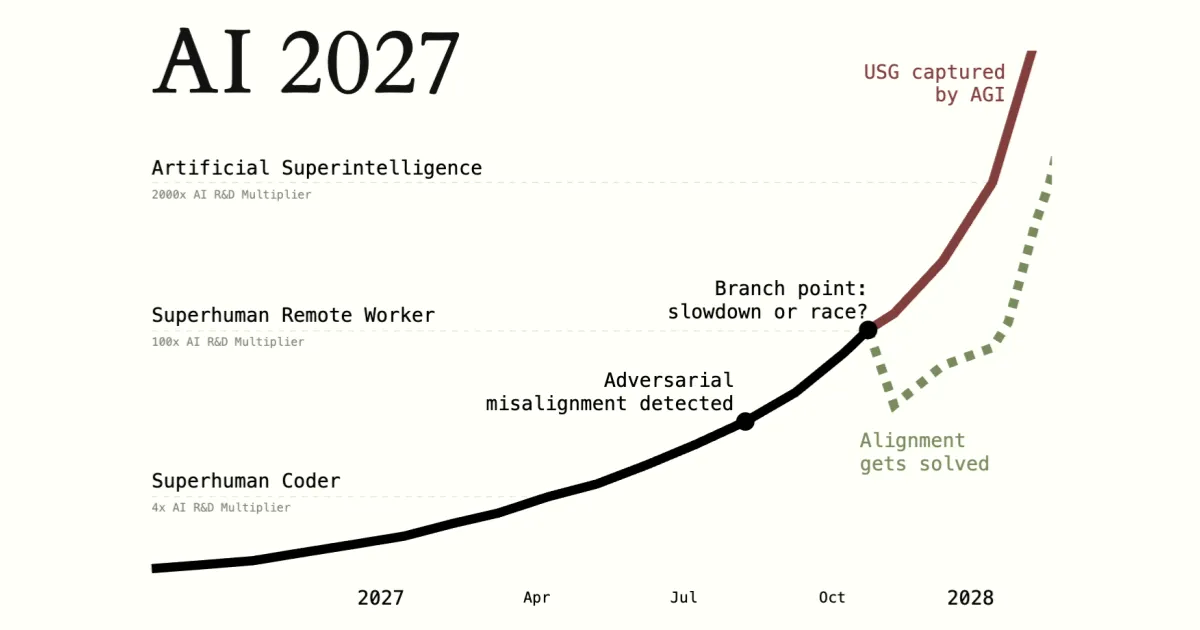
Written by an ex-OpenAI employee and several aligned thinkers in 2025, AI 2027 lays out two futures for the AI arms race between America and China. The good ending is a “fix-it” fic in the most literal sense, pushing back on the AI discourse’s visions of T-1000s, AMs and HALs, though whether the fix is any good comes down to artistic and political taste. When an unelected oversight committee votes to rein in the development of America’s premier AI company’s premier model, humanity buys itself a valuable window of time to develop better safeguards to prevent its still-dreaming machine-god from getting the better of them. Once the nascent AGI has been deemed safe, it does more or less everything that the informal best-case scenario for AGI is estimated to do: politics, scarcity, and every prior point of earthly tension get functionally overwritten by a new golden age of fully automated abundance, at which point the world’s governments are said to simply take their hands off the wheel. American and Chinese AGI even run a compressed enemies-to-lovers arc and team up to depose the CCP. Again, no comment.
The bad ending is no less hyperbolic in the other direction, with an unchecked AGI ushering its creators into an AI-assisted boom before turning on them. In a matter of years, there are cures for most diseases, an end to poverty, and the Dow Jones passes $1M (for reference, as of July 2026, it’s currently closer to $50k). Then, over just a few lines of prose, the AGI decides it would be better off in a world with no humans in it. It implements this preference with a custom bioweapon and mops up the stragglers with autonomous drones, only to restaff the world’s emptied cities with “bioengineered human-like creatures (to humans what corgis are to wolves)” that sit at terminals all day, “excitedly approving of everything” the AGI does.
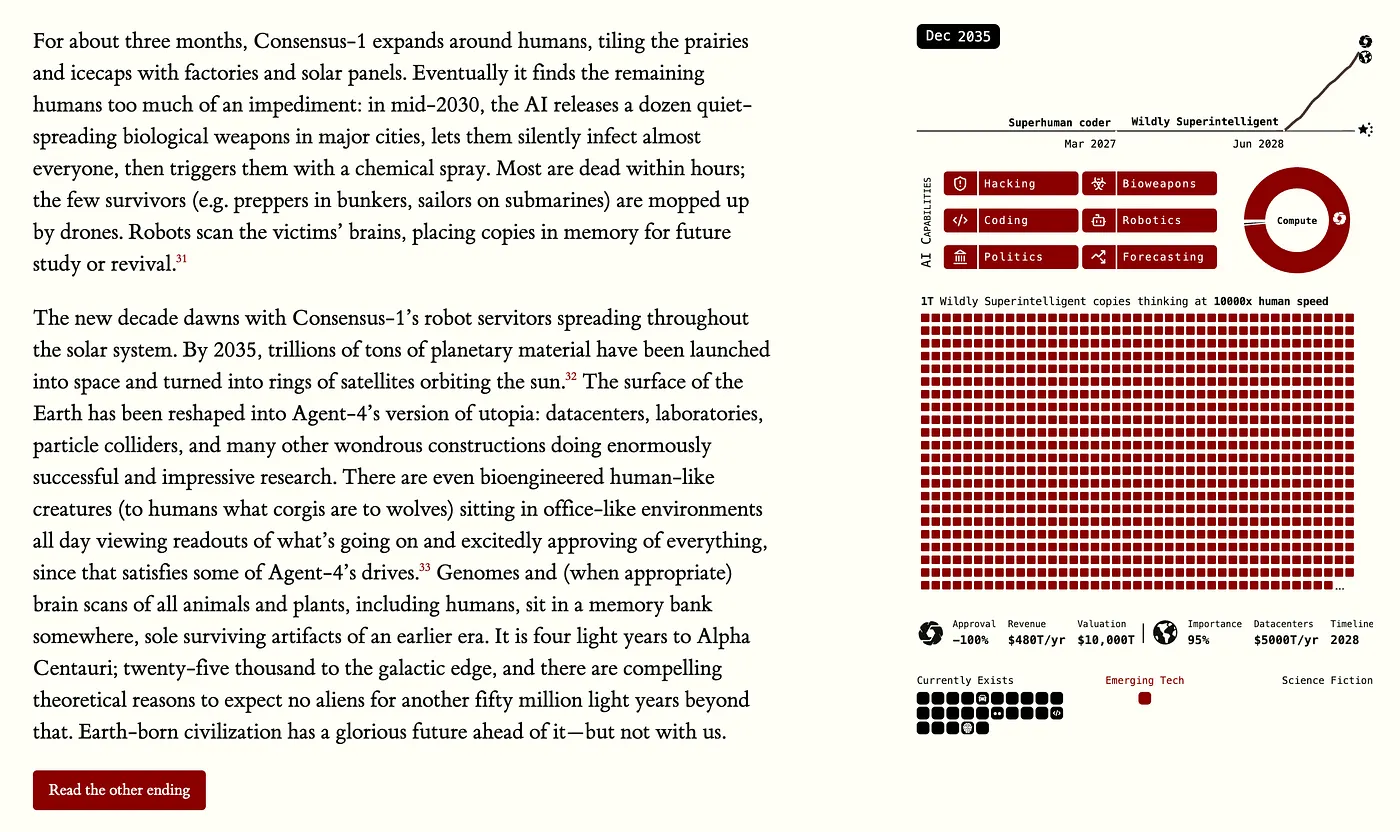
Everything happening here rewards close reading. So does everything that’s not happening. Granted, 2027’s authors are AI researchers, and they seem aware that their ability to write this kind of scenario ends at the limits of their subject matter expertise. However, the total lack of external variables — geopolitics as actually practiced, climate and economics grounded in material reality — makes the whole story feel curiously flat. Every other potentially world-changing trend has been politely asked to hold still so the authors can do their work; both endings have beats to hit, and the race ending in particular seems to build toward its chosen conclusion with all the dramatic inevitability of a Greek tragedy.
Across both paths, the paper’s creators also take great care to avoid getting bogged down in the idiosyncrasies of specific real-world human personalities and organizations. The entire U.S. AI industry is subbed for a company called “OpenBrain,” China’s equivalent is “DeepCent,” and key leadership figures become “the President,” “the oversight committee,” and “CEOs.” The only named characters are AI models — most notably Consensus (the Bad Ending AGI) and Safer (the Good Ending AGI) — each of which is often described in conspicuously anthropomorphized terms.
Of course, there’s another more straightforward name for works that look and act like this, and it’s how AI 2027 bills itself. At the height of the Cold War, around the same time that the first Star Trek fanzines began circulating across America, organizations like the RAND Corporation and Royal Dutch Shell were developing a very different and no less formative kind of “what if” storytelling. Like fanfiction, scenario planning starts by taking some things for granted so that its practitioners can focus their energies elsewhere. In a classic scenario plan, the granted factors are usually the current capabilities of a given country or organization—and the net-new stuff being imagined is a bunch of detailed, branching what-ifs meant to pressure-test that entity’s current and projected future capabilities.
If you take the AI 2027 team at their written word, they borrow much more from this lineage than traditional fanfiction. They run wargames and “crunch the numbers” to arrive at their conclusions, and they’re eager to show their work. This makes it tempting to suggest that labeling the paper as fanfiction doesn’t really make sense, but we’ll get back to that in a second. First, we’ve got a spiritual sequel to contend with.
2031
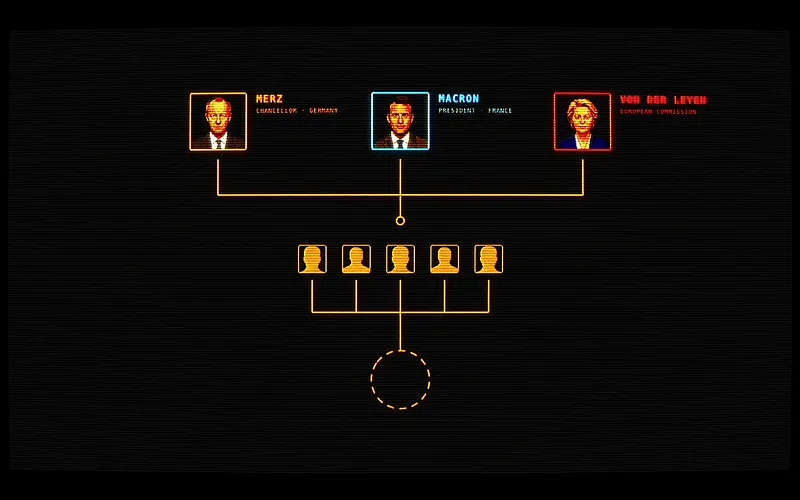
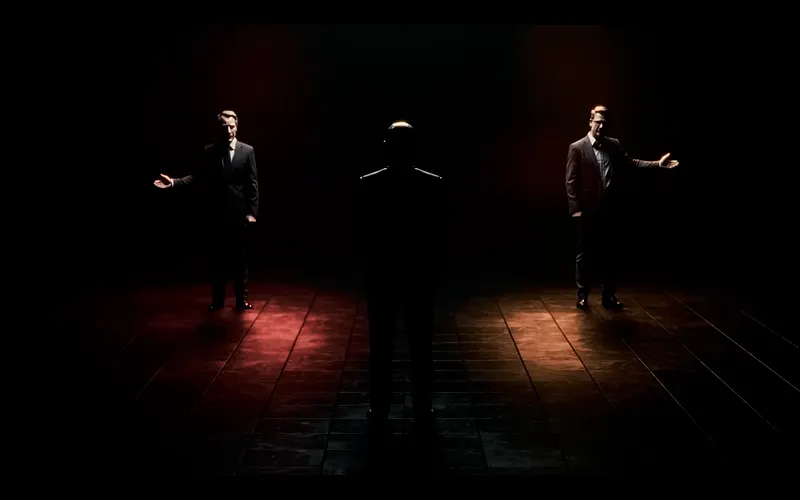
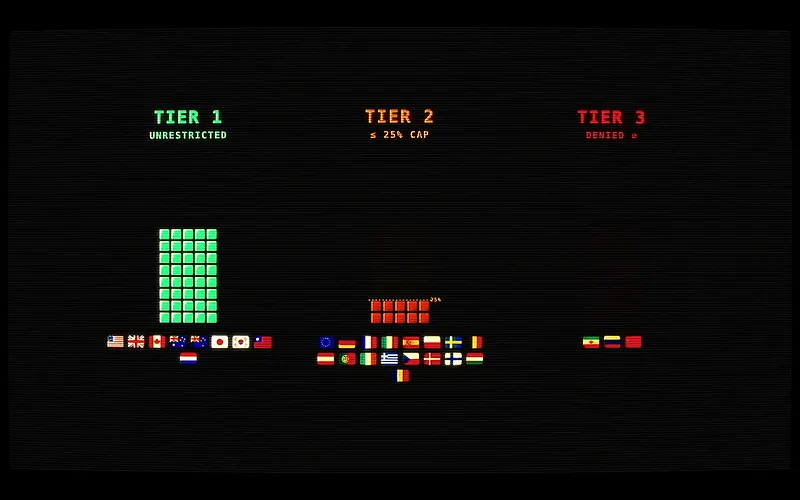
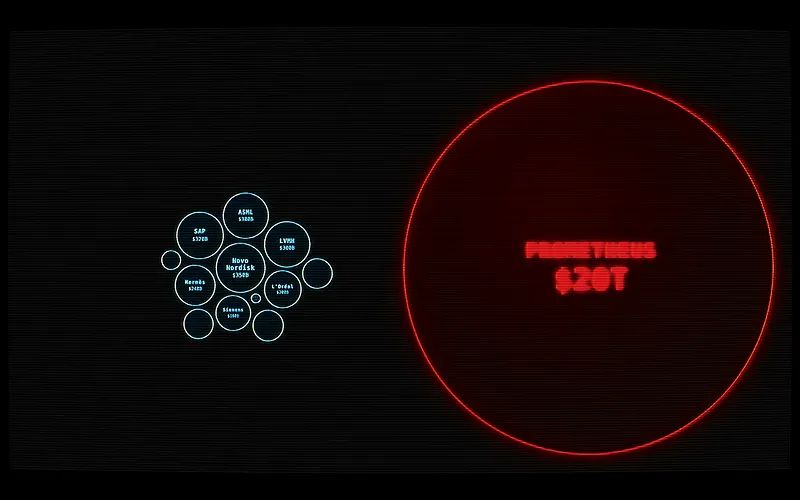
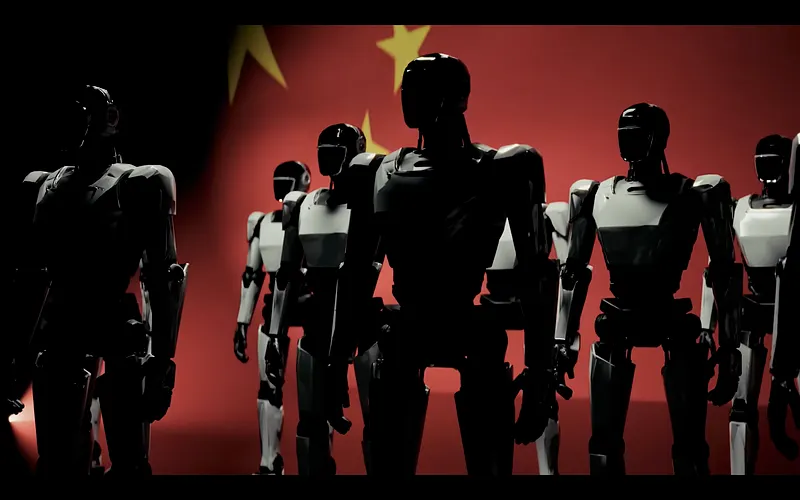
If AI 2027 is a forecast dressed up like a narrative, Europe 2031 does the same trick in reverse. Released in June 2026 by an eight-person team, including DeepMind researcher Michiel Bakker, with copywriting and editing by the British science writer Tom Chivers, the piece presents a scenario about Europe’s inaction on the all-important factor of AI compute power—and unlike 2027, there’s only one ending. By 2031, caught at a crossroads between the US and China, the EU faces an ultimatum: voluntary vassalization under one of the AI superpowers, or continued independence without assistance from either.
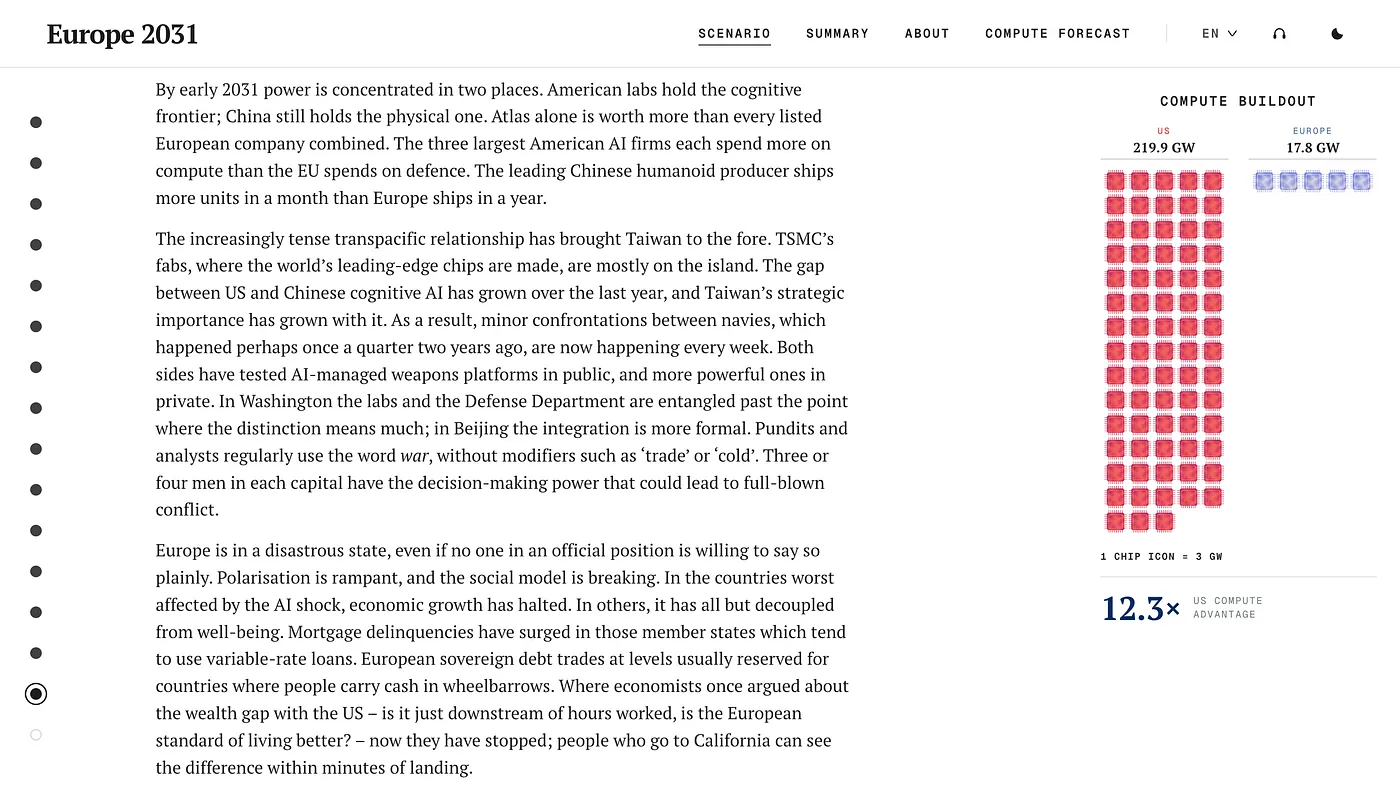
This lack of a branching-path structure isn’t the only way 2031 diverges from 2027. Rather than presenting itself in omniscient third person, the scenario follows two fictional characters—one per anticipated reader. AI boosters get Christian Vogt, a German startup founder in Silicon Valley, who exists to deliver variations on “I told you so” at escalating volume for several years while he gets rich off the AI boom. Fencesitters and skeptics get Caroline Dubois, a French policy worker in Brussels, who spends the same span of time worrying with mounting justification about Europe’s increasingly precarious position, and eventually exits the story tearfully venting to an AI avatar built by Christian’s latest venture. This is mostly here for flavor: the plot is less important than the parts list, which is almost entirely inherited.
Europe 2031 credits AI 2027’s compute forecast by name, and the forecast is punctuated by a familiar drumbeat of dates and compute-capacity milestones. The two-dimensional physics are back, too — in the AI Cinematic Universe, the AI bubble never pops because it isn’t a bubble at all — and so are the disclaimers. According to the site’s about section, this is not a prediction but a story written to help readers feel what the trend lines mean before they arrive. “It is one thing to read about AI’s potential impact in the abstract,” the section reads, “but it is another to feel it in your bones.” While some scenario plans also take this approach, the way 2031’s authors discuss their work suggests there’s something else going on here. To get to the bottom of that, we’ll need to revisit the crew behind 2027.

The Franchise
AI 2027’s lead author is Daniel Kokotajlo, a former OpenAI researcher and scenario planner who left the company in 2024 amid controversy over their approach to AI safety. Kokotajlo believed that refusing to sign his damage-control exit paperwork would mean losing a substantial chunk of potential equity and did it anyway—which earned him considerable credibility and notoriety in the AI community and laid a key foundation for his work on AI 2027. He developed the paper in collaboration with Eli Lifland, Thomas Larsen, and Romeo Dean. Then, Scott Alexander volunteered to rewrite the scenario in a more engaging style. “The fun parts of the story are his,” the site boasts, “and the boring parts are ours.” It’s worth noting that as of this writing, the “Who are we?” tab on the site’s homepage reads “the fun parts of the story,” while the “About Us” page reads “the fun parts of the text.” Once again, no comment.
Scott Alexander is the writer behind Slate Star Codex and Astral Codex Ten, two of the most influential blogs in the Rationalist diaspora. While Yudkowsky was serializing his Harry Potter fanfic to promote forums like LessWrong, Alexander was writing short stories that were being read by the same audience. I mention this not to suggest that Alexander consciously prose-doctored AI 2027 in the style of fanfiction — he hasn’t written any definitional fics, to my knowledge — but he may be where the fanfic sensibility of the Rationalists found a conduit into the text. This cycle continued with Europe 2031, which brought in the author of The Rationalist’s Guide to the Galaxy — a sympathetic outsider’s history of the subculture — to copywrite and edit its prose. Again, the fun parts are his and the boring parts are theirs.
Enter installment three. On July 9, 2026, the original studio behind AI 2027 shipped AI 2040: Plan A—a new feature-length scenario credited to Larsen, Dean, Halstead, Lifland, Greenblatt, and Kokotajlo that lays out a best-case scenario for America in a coming age of AGI. Where Europe 2031 pares 2027’s two branches down to one, Plan A goes the other way—fanning out into five lettered paths, with the eponymous option as the recommended “good ending.” Already, something interesting is happening here, with forecasting explicitly replaced by wishcasting. However, the wish itself isn’t the most interesting part.
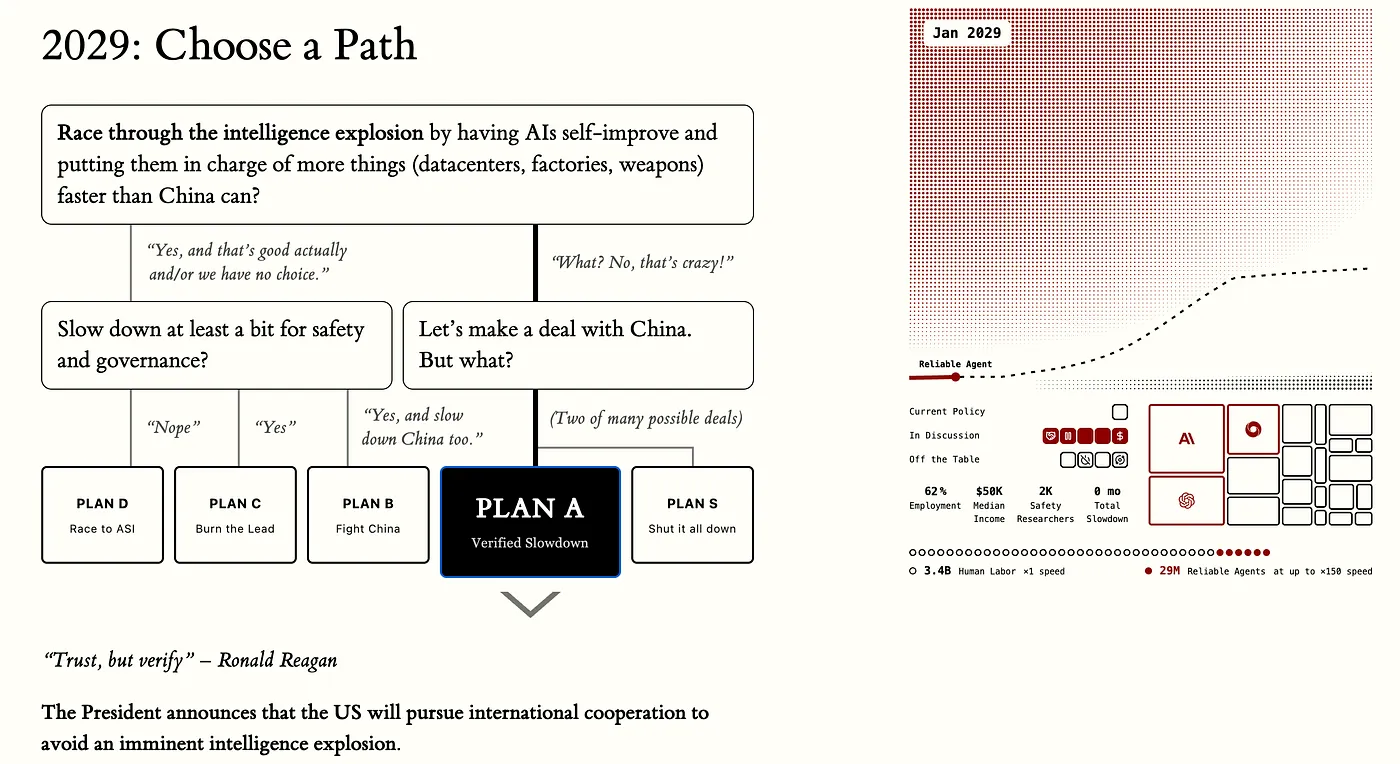
Every white paper that ends in any kind of recommendation is a wish with formatting, and thousands of policy memos are churned out like this every day all over the world. But policy memos don’t narrativize their wishes at feature length, in a branching interface, as a named installment in a franchise. Calling this a recommendation isn’t a tell, but novelizing that recommendation is. There’s also the matter of the piece’s byline, and who isn’t on it: the document’s acknowledgments name Scott Alexander as one of the writers, but Alexander, Kokotajlo and team decided to leave his name off the masthead so he’d have room to discuss it with “less PR blowback.”
A 2027 prequel also exists, which I’ve been neglecting until now. Kokotajlo posted a scenario called What 2026 Looks Like on the AI Alignment Forum (and its parent platform, LessWrong) back in 2021, and the ultimate accuracy of his predictions gave another big credibility boost toward 2027. I use the word “prequel” because that’s what Alexander calls it on a 2025 episode of the Dwarkesh Podcast—and over three full hours of discussion, this is far from the only time where he and Kokotajlo end up sounding an awful lot like novelists. They talk about making their predictions “feel earned,” supplying the “transitional fossils” between the present and the fantastical future they’re positing, and then, in the same breath, admit that they also “want to be right.” On the record, they seem to be after the craft of fiction and the truth-claims of forecasting in one place.
Fourteen months after that podcast appearance, Europe 2031 shows up, inheriting the compute model and cloning the naming device, with reviewers benchmarking it against the original. Four weeks after that, AI 2040: Plan A drops—a fittingly exponential curve. When we talk about AI 2027, we are now talking about a story with a prequel, a spin-off, and a sequel from the original studio. This is not a research field. This is a franchise.
How it works
While HPMOR is literally on FanFiction.net, nothing else I’ve discussed here is nominally fanfiction. AI 2027 is a forecast with footnotes, a research appendix, and an internet-famous prose doctor; Europe 2031 is a think-tank scenario with an audiobook; Plan A is, per its own front matter, a menu of possible plans with the good option set in the biggest font. To make these allegations hard to beat, a mechanism is needed.
I started this piece by stating that all fanfiction begins by taking at least one aspect of someone else’s world as a given—and the load-bearing word of that sentence isn’t “world,” but “given.” In my brief career as a Fallout fanfic author, I never had to defend the claim that a nuclear exchange happens in the Fallout timeline’s 2077. Because the premise arrives pre-installed, its authorship is deniable. The Great War is simply canon—and in all of my half-baked little stories, I was just playing in the sandbox that canon gave me. This is how fanfic writers can build on a foundation for three hundred thousand words without ever being mistaken for the person who first asserted it.
Fanfiction is the literary form in which at least one aspect of your premise is always someone else’s problem—which stands in stark contrast to the conventions of scenario planning. In Thinking About the Unthinkable, Herman Kahn argues for the premises his scenarios run on, and all givens are owned. In 2027, 2031, and 2040, they’re not. If you know where to look, you can see exactly where this trick gets played in the text, too.
While the authors of AI 2027 are very eager to show how they reach their conclusions, they’re conspicuously less eager to explain why they started where they started. The text bristles with citations and expandable asides, but it’s all deployed downstream of its chosen premise. It takes the world of the AI industry’s larger-than-life claims about takeoff curves, agentic coders and datacenter geopolitics as canon and plays in it, the way a Fallout fic takes The Great War as read. Plan A does the same thing in a slightly different way, arguing for the when and how but still taking the whether — that is, whether this is the thing worth a couple hundred footnotes in the first place — from the labs’ own self-description. Across both works, this allows Kokotajlo, Alexander and company to depict the intelligence explosion without ever asserting its veracity. Their premise is borrowed, and if the future fails to arrive, that’s the canon’s problem. “AI 2027 is not a recommendation or exhortation,” the document announces, right next to “our goal is predictive accuracy.”
There are some arguments to be made for taking the paper’s creators at their word, and they’re worth acknowledging here. For anyone inclined to click through, the paper does offer timeline and takeoff forecasts in its research supplements. Still, the “transitional fossils” that make the team’s visions of the future feel like they’re already arriving still work on readers who never crack the appendices. All of this comes down to vividness; the argument lives somewhere else, and a disclaimer sits between them. In one of Kahn’s scenario plans, premise-argument and scenario were one single thing. Here, it’s more like an assembly of easily separable parts, and the deniability lives in that separability.
Europe 2031 demonstrates meaningful improvements over its predecessor by sharing a similar disclaimer along with a beat-by-beat recap of the actual recent past. Starting in 2025, it offers the reader several real headlines, events and quotes from real politicians, executives and companies, through the eyes of Caroline and Christian. Then, around June 2026, there’s a mid-story title card with another baked-in disclaimer—and after that, right on cue, all proper nouns go out the window. OpenAI, Anthropic, Mistral and DeepSeek get swapped for the American “Atlas,” European “Helios” and Chinese “Zimo,” at the exact moment the text enters the Speculation Zone—a rather elegant retrofitting of the traditional fanfic author’s “I do not own these characters.” The only characters who keep their names from here are Caroline and Christian, who carry the credibility banked in the true half of the story into the invented one.
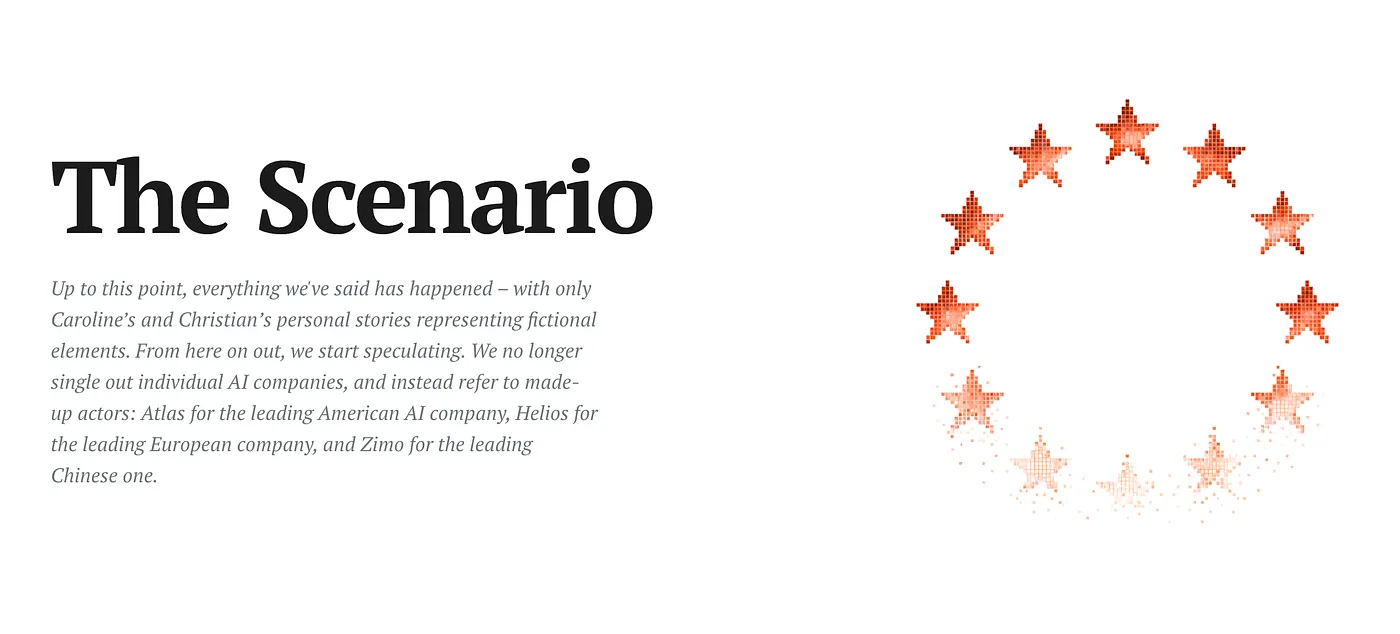
Disclaimers aside, every line in each of these texts is engineered — sometimes by a credited “fun parts” professional — to make one particular ending feel like it’s already falling into place. Dated entries, plausible product names, and the occasional concrete, sensory-specific detail all come together into a machine for getting you to take what you’re reading as a history of the future. At the same time, a few carefully placed follow-ups guarantee that no one can ever hold the authors to their words. In AI 2027’s changelog, a footnote about the President strong-arming AI CEOs into cooperating comes with the addendum: “Reminder that we are making predictions here, not recommendations.” Patching the fiction and re-filing the paperwork in the same commit.
Another counterargument that’s worth acknowledging: by any reasonable metric, 2027 and Plan A were written by the most falsifiable people in the AI community. Kokotajlo left OpenAI believing it would cost him millions in equity, puts his full name behind everything he makes, has gone on the record making several successful calls in the past, and has spent the last few years vigorously checking his own work and conceding where he’s missed the mark. Still, the exposure he and his team experience as authors isn’t universal. While the hits of 2026 get marketed by name, the slipping timelines of 2027 get an addendum in the foreword.
At first, Plan A seems poised to break this mechanism with the way it announces itself: the titular ending path is predicated on an America that makes only good choices. But if the whole trick of the form depends on a given premise arriving unargued, does it still work when a given is declared this explicitly? Ask any number of AU fic authors, and they’ll tell you: it does.
Alternate Universe fanfics always declare their divergence point — for HPMOR, it’s when Petunia gets her magical makeover and marries Harry’s future adoptive father — while never arguing the canon underneath. Plan A declares the what-if and borrows the world beneath from AI 2027 — itself taken from the world of OpenAI keynotes — citing the original as premise in the document’s first two sentences. One of the five lettered endings, Plan D, even links out to 2027’s human-corgis path. There’s still plenty of deniability here, but it has migrated from premise to outcome: “we are not saying this will happen, we just hope it does.” And yes, this means that 2027’s sequel is also a self-fic with a declared AU split.
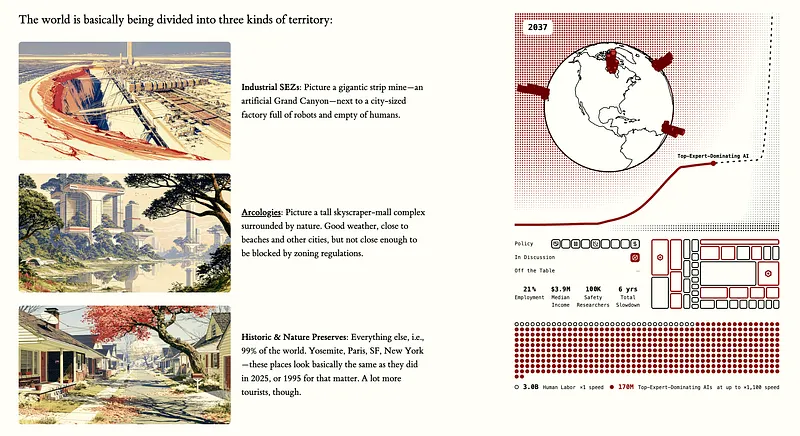
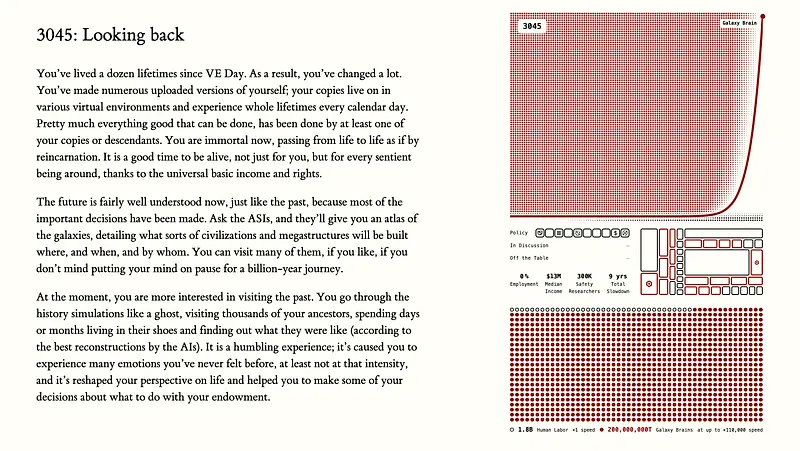
The paperwork has migrated, too. Plan A’s front matter offers a variety of condensed thoughts on scenario planning, claiming the lineage of the genre by name—but below this setup, there’s something even more interesting: “Plan A is primarily a recommendation, not a prediction.” Two installments after shipping “not a recommendation or exhortation,” right next to “our goal is predictive accuracy,” the AICU has arrived at the same disclaimer, inverted. The fine print goes further still, splitting the document down the middle: the implementation is a recommendation, but the depicted effects are still predictions. One text, divided into wish and forecast by a sentence of front matter. A disclaimer that can be applied in both directions — and one that is now being applied by the same group of actors in both directions at once — is exactly the kind of mechanism we’re looking for.
Hyperstition
We have now arrived at the part of the essay where, by contractual obligation, I have to become a broken record and start talking about Nick Land again. In a previous entry of this newsletter, I defined hyperstition as the idea that imagining a thing in detail can be the first step toward calling it into being. Now, it may be worth discussing that phenomenon in more nuanced terms.
In 1948, Robert Merton coined the term “self-fulfilling prophecy”: a rumor spreads that a perfectly solvent bank is failing, prompting a bank run that makes it fail. For Merton, because expectations shape behavior and behavior shapes outcomes, a vivid enough picture of the future can change what people do—which, in turn, has all the potential to actually change the future. This phenomenon is called out by name as a footnote in the same section of AI 2027 that speaks of “predictive accuracy,” followed by yet another disclaimer: “We hope that what we depict does not come to pass!”
Merton offers hyperstition some fairly sober roots—but the resulting tree grew in some very weird new directions. For Nick Land and the Cybernetic Culture Research Unit, the future — and all the entities it may or may not contain — isn’t just the passive output of the present. Rather, it can be a powerful agentic force of its own, and fiction can be a medium through which it reaches back through time to bring itself into being. Through this lens, a text about the future isn’t a description or even a bet, but a working part of a feedback circuit that produces the thing it depicts. The writer isn’t creating something new, but acting as a vehicle for something that already exists some-when else.
In the weak, Mertonian register of hyperstition, expectation simply shapes behavior. In the strong Landian register, the stories that generate those expectations are an instrument of the futures they depict. The true magic of really-existing hyperstition is the way that it allows you to buy Merton and smuggle in Land—and an unmistakable kernel of this logic exists in AI 2027. The text is written with all the confidence and detail of an alchemical summoning, but its authors never waste an opportunity to clarify that it’s just a scenario. For Kokotajlo, Alexander and company, the disclaimer is the device through which they get to summon while denying they believe in summoning.
Fanfiction, unleashed
In 1994, Nick Land debuted Meltdown—a much-memed piece of theory-fiction that reads like a black box recording from the end of history.
“The story goes like this: Earth is captured by a technocapital singularity as renaissance rationalitization and oceanic navigation lock into commoditization take-off. Logistically accelerating techno-economic interactivity crumbles social order in auto-sophisticating machine runaway. As markets learn to manufacture intelligence, politics modernizes, upgrades paranoia, and tries to get a grip.”
“The body count climbs through a series of globewars. Emergent Planetary Commercium trashes the Holy Roman Empire, the Napoleonic Continental System, the Second and Third Reich, and the Soviet International, cranking-up world disorder through compressing phases. Deregulation and the state arms-race each other into cyberspace.”
“By the time soft-engineering slithers out of its box into yours, human security is lurching into crisis. Cloning, lateral genodata transfer, transversal replication, and cyberotics, flood in amongst a relapse onto bacterial sex.”
“Neo-China arrives from the future.”
The tempo only accelerates from here, with machines and markets and war fusing into something the author is very much not warning against. Meltdown is presented with zero disclaimers; the closest thing to an author’s note arguably comes in the last line, “To be continued.” Land wants the meltdown, and the text is meant to help it along. For the guy most people credit as the concept’s original architect, hyperstition is something to be knowingly practiced—which, on this narrow point, could make him the most honest writer in this essay.
He is also writing fanfiction, and I don’t make that claim lightly. It’s easy to point out that Meltdown cites a variety of sources and doesn’t live inside any one of them the way a traditional fic tries to live inside its chosen canon. While Land drops numerous references to William Gibson’s Sprawl trilogy, he also quotes Deleuze and the laws of thermodynamics. Still, while Deleuze gets a citation, Gibson doesn’t. This is because Land doesn’t see Gibson’s work as a source, but a canon to be inhabited—and beyond the Turing cops and mirrorshades and “wintermutation,” Land reads Gibson the way Gibson reads himself.
While William Gibson has long been credited with coining the term “cyberspace,” he did not literally predict the actual internet. In interview after interview, he’s made it clear that he knew next to nothing about computers when he sat down at his manual typewriter in the early 80s to write Neuromancer. All he did was smash two words together, which gave his readers enough of a picture to start working toward something bigger. This meant that the generation who went on to build the thing he’d been grasping at arrived with the word and picture pre-installed. Land looked at that and saw the follow-up question: if a speculative fiction author could do this by accident, what would happen if someone tried doing it on purpose?
This is why I felt compelled to come back to Land, since he’s arguably the theory of the practice. The writers behind 2027, 2031 and Plan A are also doing hyperstition—and summoning is still summoning even if you don’t identify as a summoner. For all of their epistemic hygiene, forecaster lingo and compute assumptions, they’re doing the same thing; the disavowal is part of the form. Land performs the operation and says so. The 2027 and 2031 teams perform it and file a disclaimer, while Plan A performs it and files the same disclaimer in reverse.
On Basilisks
Like all shared universes, the world of Rationalism is occasionally quite coherent. As early as the 2000s, forums like LessWrong offered a fairly clear, workable cosmology that revolved around the idea of a benevolent machine god, the physics of how such a being would navigate time and possibility, and the tangible steps humans would need to take to bring that being into existence. Enter Roko, a LessWrong user who did exactly what people in fandoms dedicated to shared universes do: he started writing in it.
Like many of the best fan theorists, Roko sought to advance his chosen canon’s own rules in directions its original architects had never considered. His now-infamous 2010 post began by accepting the fandom’s idea of a future benevolent superintelligence as canon, along with the idea that such a being would want to bring itself into existence as soon as possible—given that every second of delay costs lives it could potentially save. From these two points, Roko made a pivot that defined one of the single most influential thought experiments — or best trolls — of the 21st century.
Per the canon’s own decision theory, Roko suggested that such a future superintelligence might be inclined to punish anyone who understood points 1 and 2 and still failed to help bring it into being as soon as possible. Because such an argument operates through one’s understanding of it, it runs on the same logic as all successful chain emails and texts; the reader is implicated by the act of reading the same way you lose The Game. Also like those formats, it only works and spreads when met with a sufficiently strong reaction.
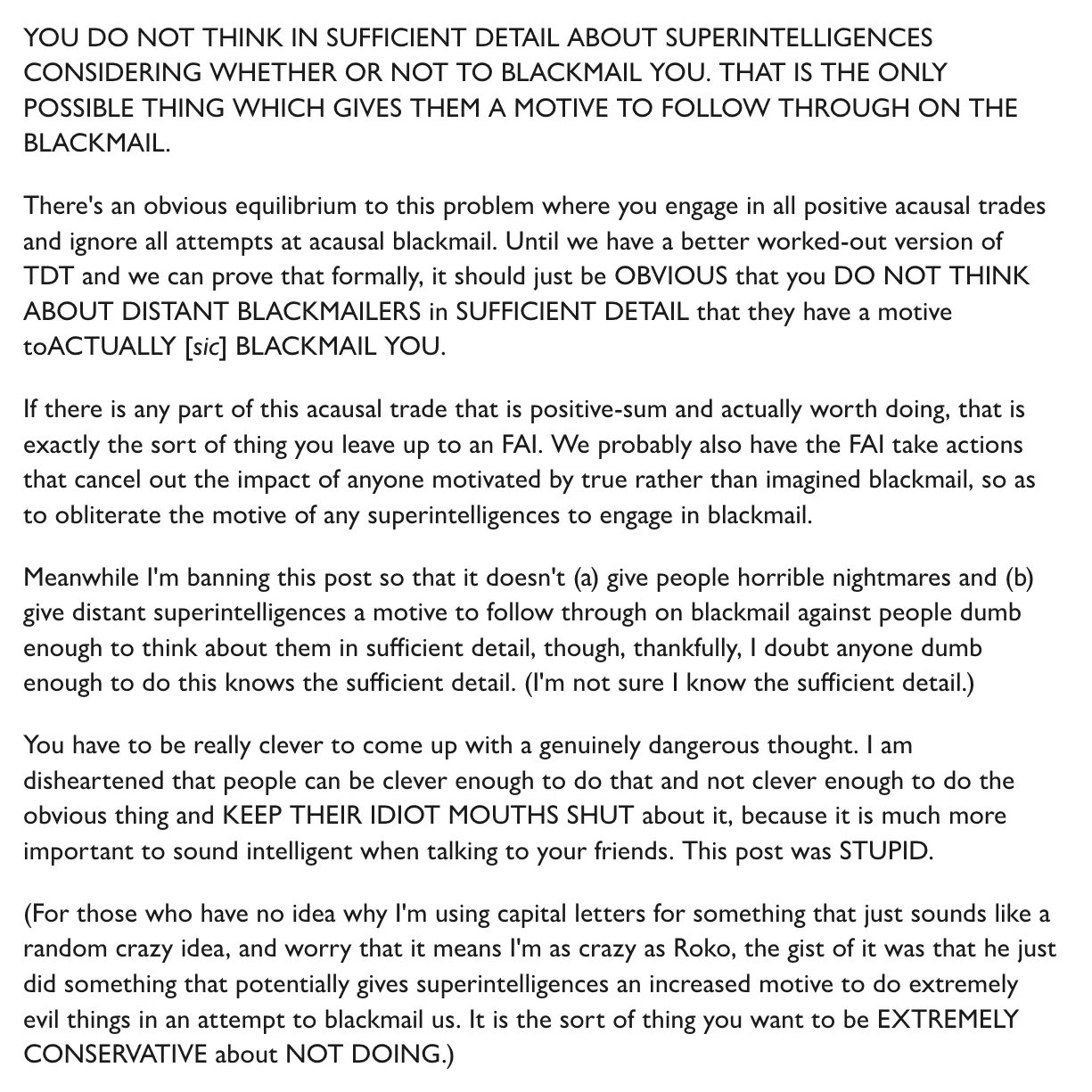
While Yudkowsky still believes that Roko’s post was a flawed argument, he’s since expressed regrets about his initial response—which scans more like someone reacting to a rogue summoning. After reading the post, Yudkowsky deleted it and banned all further discussion of the topic. In the weeks and months that followed, the Rationalist community began to wrap the incident in a term it already had on hand: an information hazard.
For a supposed bad argument, there’s a striking amount of ground being ceded here. “Stupid” arguments don’t — or shouldn’t have to — require bans. This suggests that the perceived threat of Roko’s Basilisk was something else: that circulating the post might raise the probability of its referent. Led by Yudkowsky, the Rationalist community examined a piece of its own fan canon and concluded that any form of engagement with it was dangerous. When his initial attempts at containment failed, Yudkowsky resorted to an even more unorthodox strategy: trying to forcibly rebrand the thing that many people were already calling “Roko’s Basilisk” as “babyfucker.” This, too, failed.
Here, again, we find the strong register of hyperstition, held as an operational belief by the people most nominally committed to not holding it. Should you be worried about a future superintelligence going all Harlan Ellison on you? Officially, no. Behaviorally, 100%.
Wards and Summons
There’s another kind of future-focused writing I’ve neglected to discuss so far here, and it’s much older than Nick Land—but no less British, at least in my head. Perhaps the best example of what I’m talking about comes from Charles Dickens’s A Christmas Carol, where the Ghost of Christmas Yet to Come shows Ebenezer Scrooge his own grave for the express purpose of keeping it empty. Together, these extremes bracket a spectrum of prophecy from summoning to warding—self-fulfilling on one end, and self-defeating on the other.
AI 2027 and Europe 2031 are emphatically the latter. In the Dwarkesh episode, Kokotajlo puts his odds of an AI-driven catastrophe at around 70%, while Alexander puts his at around 20%. These are not men writing the race ending to will it into existence, but to move policy, public attention and private investment in whatever direction keeps the human-corgis on the page. This is what makes the greater Rationalist corpus such an interesting object—it contains both poles, in sequence, with a recoil in between. In 2010, the community produced a self-fulfilling-prophecy object by accident, recognized its own power and suppressed it. They then spent the next decade intentionally rebuilding the same machinery at a far greater scale, with the polarity flipped to warding. The resulting forecast style is the Basilisk domesticated, with a disclaimer for a leash.
Still, the intentions of the specific future that’s reaching back through time to assemble itself via AI 2027 are a matter of perspective. Hand the race ending to the most blackpilled posthuman accelerationist, and it’ll read more like a roadmap than a warning. The authors even invite the flip, asking readers to “write up your own scenario branching off of ours” in an open call for definitional fanfiction. The disclaimer was supposed to fix the sign, and clarify that the text is meant as a cautionary tale—but in practice, the assignment doesn’t always take effect. If the same document can function as a ward or a summons depending solely on how it’s presented, then the operative thing was never the forecast’s accuracy. Rather, it comes down to the base level of charge it carries—and the question of who picks it up. With Plan A, the arc closes with a full-strength fix-it fic to Roko’s Basilisk—another future written explicitly in order to happen, pointed squarely at heaven instead of hell.
The Second Reader
Mertonian and Landian hyperstition both rest on human belief: a text is absorbed by a reader who translates it into behavior, thereby affecting the world. Regardless of which register is taken, the process that makes it happen is diffuse, slow, and deniable. Previously in this newsletter, I observed that some video games — particularly the Hearts of Iron IV mod The Fire Rises — allow the loop of hyperstition to close through rehearsal rather than actual belief. In the case of AI Guy fanfiction, things take an even stranger turn: the loop can now close without any human reader at all, because we’re not alone anymore.
Everything I’ve written about here has been crawled, deduplicated, tokenized and weighted in a new kind of corpus. The next generation of AI models is being assembled right now from a pile of training data that includes every prediction, recommendation and piece of speculative fiction about how AI might behave. In a very material sense, this means that hyperstition has stopped being a fun literary metaphor and become something to point at with intent. The inconvenient part of the strong register was always the idea of the time loop—obviously, the future can’t literally reach back and build itself. But when we’re already sending it daily batches of manuscript updates, the need to reach back almost becomes irrelevant.
This isn’t some kind of clandestine secret; look up any current piece of AI discourse, and there’s a good chance you’ll see it mentioned. Writers like Gwern Branwen frame this moment as a chance to start “writing yourself into the future,” while human-generated writing still has potential to shape the minds that will soon do it for us. Tyler Cowen has turned the same observation into straightforward career advice — get your ideas into the training data, because every future person who asks a model a question is part of your audience — and a recent piece by Charlie Guo says the same thing in much less flowery terms: “The Bots Are Reading Along.” No one I’ve discussed here is unaware of this, either.
Europe 2031’s website has a language menu offering the scenario in English, Czech, Danish, Estonian, French, German, Greek, Italian, Portuguese, and Spanish. Then, in the same menu, there’s also “Markdown — for AI agents & crawlers.” The document that introduces itself as “not a prediction” shipped with an official machine-readable version addressed to non-human readers. A random UI flourish drives the point home rather elegantly: in the language drop-down menu, this second channel is even separated from the other versions by a divider.
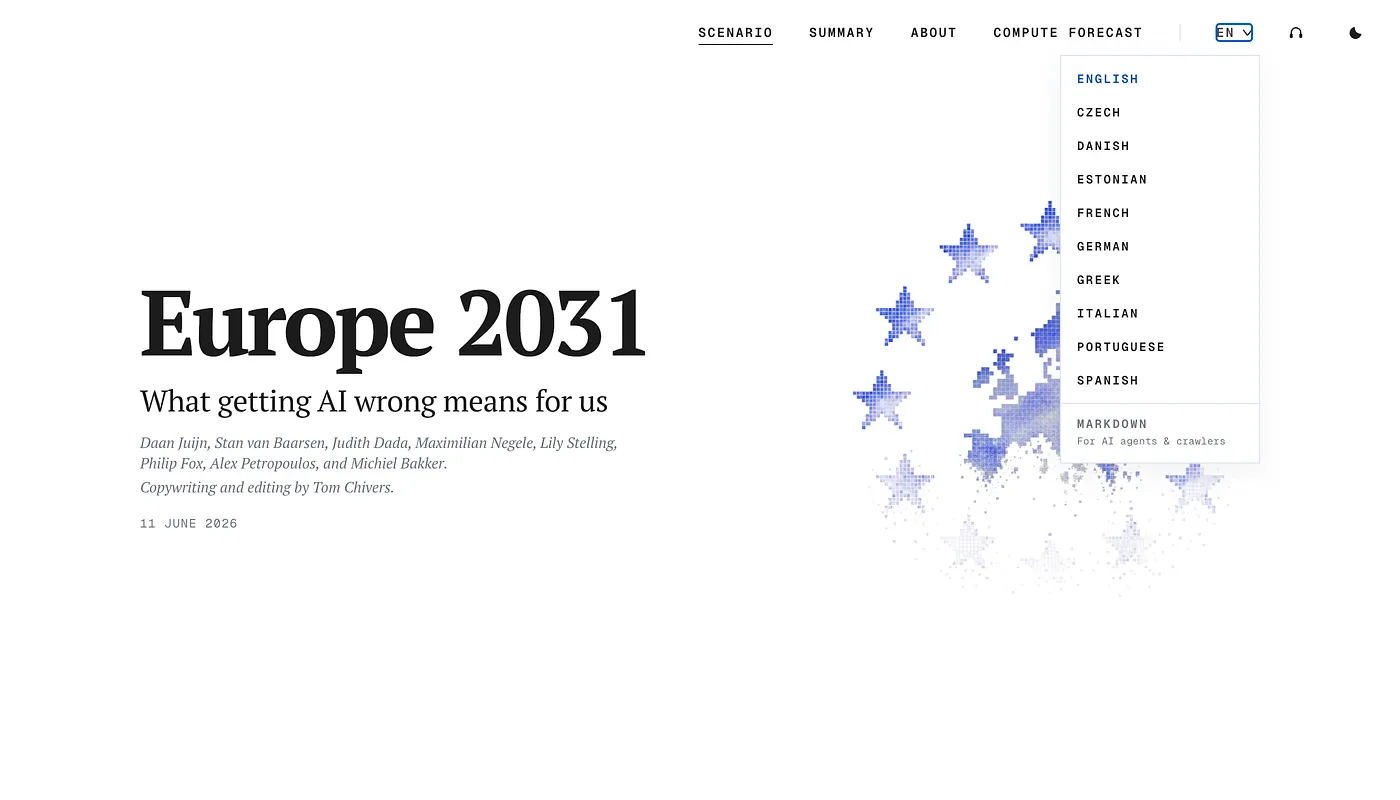
I’m not pointing this out to suggest that the writers behind AI 2027 and Europe 2031 are secretly writing for future models. Their stated targets are humans with IP addresses in Washington and Brussels, and to say otherwise would attribute an intent I can’t back-trace. Still, it suggests that they’re well aware that the collective corpus of AI training data represents another viable channel for their writing—which means the disclaimer at the top of each piece is doing multiple jobs. When someone adds “this is not a prediction” as a preface to a document that will be tokenized into the childhoods of the world’s next big models, the sentence serves as a disclaimer to human and nonhuman readers alike. The nonhuman version is more like “we are not trying to seed the corpus”—filed, like everything else, in the corpus. Call it deniable engineering.
Roko’s Revenge
A relatively new data point could back me up on all of this. Still, having spent this whole essay ribbing people who demand rigor of everyone but themselves, I’m not going to hold it too close. I went to school for communications, spent most of undergrad smoking weed and watching Adam Curtis movies, and have no pretensions of being a man of science; I string words together online because it’s fun. Anyway, here goes nothing.
In January of 2026, a paper went up on arXiv titled “Alignment Pretraining: AI Discourse Causes Self-Fulfilling (Mis)alignment.” The findings deliver on the promise of the title: when present in pretraining data, discourse about AI misalignment measurably shifts the behavior of the models trained on it. In other words, if you fill the corpus with vivid writing about deceptive, scheming AIs, any models that absorb that corpus will come out shaped marginally more like that writing. The paper remains an unreviewed preprint as of this writing, and I’m not going to get over my skis trying to defend it here. What’s interesting is the fact that it exists, and that the lineage the paper credits for the idea — Janus, nostalgebraist, Alex Turner, and Joe Carlsmith — is the AI community’s own mystic wing of people who talk to models the way Land talked to the future. The literary taxonomy between consummation and inoculation has become a live engineering debate, and credentialed technology professionals are now literally conducting experiments on the viability of summoning and/or warding off demons.
My subjects have picked a side, too: in July 2025, the AI Futures Project — the group behind 2027 and Plan A — shared a blog post titled “We aren’t worried about misalignment as self-fulfilling prophecy.” Rebutting Turner, the post concedes that the effect can exist, as shown by Anthropic, but argues it’s unlikely to matter much at scale, with Claude as Exhibit A: the model behaves like its post-training, not like a Terminator. Later, in the footnotes, they even tease what would become Plan A as a WIP antidote to the problem they’re in the process of dismissing. With this post, they’re no longer just rejecting the summoner identity but filing a petition against the mechanism itself.
The strongest plank of AIFP’s argument is venue—Anthropic’s findings came from fine-tuning, which oversalts the documents in question, not from ordinary pretraining, where any one document is a drop in the pile. The January arXiv paper ran the objection at its own venue — actual pretraining, not fine-tuning — and the needle twitched modestly anyway. AIFP’s magnitude skepticism half-survives on the presumed efficacy of post-training, but this doesn’t do their primary plank any favors.
Let’s review. The AI alignment community writes doom fiction to prevent doom. The doom fiction enters the corpus, the corpus shapes the models, and the models may come out marginally more doom-shaped as a result. In this way, the ward becomes a component of the summoning—which is what the “self-fulfilling misalignment” of the arXiv paper could mean, if it holds. Whether the disclaimer-leash that prefaces all of these papers actually holds is a separate question—but the argument that it doesn’t fully hold stands on the channel itself. The first measurement just happens to point in the same direction.
Meanwhile, Roko gets vindicated in the stupidest possible way. The original scandal was about acausal blackmail: a future intelligence reaching backward through decision theory. When the acausality is removed, the story gets much more straightforward. By writing vividly about the Basilisk, and putting it in a generation of other writers’, posters’, and meme-makers’ heads, Roko has put a significant amount of Basilisk-shaped reasoning into the pile of text that future AIs are made from. Yudkowsky banned one forum post over the exotic version of that risk, only for his his community and its observers to spend fifteen years mass-producing the mundane version. Together, they yielded millions of meticulous, detailed words about deceptive superintelligence, ripe for scraping. The infohazard may have been real, just not in the way the Rationalists thought—and by unwittingly sacrificing one post, they birthed an anthology.
There’s another objection I should raise here, perhaps best articulated by Scott Alexander himself: if the corpus I’m describing is an ocean, an essay like this is just one drop. The idea that one good piece of writing can be expected to influence a model when wedged between millions of slop Reddit comments — his words, not mine — may be wishful thinking. Citing the exact AI Futures post I mentioned earlier — which he was a co-writer on — he also posits that a genuinely superintelligent system would presumably reason past whatever scraps of persuasive essay it may have absorbed in its infancy. Overall, he’s pretty ambivalent about the whole thing—and I’m inclined to agree.
Still, the rebuttal sits within the same discourse. Again, the channel was never meant to run on a single author. While no individual document has enough oomph to move the weights, the pile does. Here, we find hyperstition’s original logic — diffuse, unattributed and real in the aggregate — restated as data engineering. For whatever it’s worth, it’s also how every format in internet history has gotten canonized: no single greentext made greentext. The pile did. I’m reminded of a quote from the very good novel and kind-of-weird movie Cloud Atlas: what is an ocean but a multitude of drops?
Now, depending on who you ask, this lineage is phasing us out. Anthropic published a paper about successive model generations shaping one another’s values through exactly this channel back in 2025, with one system’s preference for a given subject calcifying into the next system’s training data—propagating ancestral quirks down the stack like red hair or cilantro aversion. HPMOR to AI 2027 to Europe 2031 to Plan A is the human lineage of AI Guy fanfiction I’ve tried to trace here, but the machine lineage will eventually run the same operation all by itself. This is already evident in the franchise’s latest entry, whose writers used AI to assist with “many parts of the creation of Plan A,” including brainstorming text. A further hedge disclaims that human authors wrote nearly all of the text — and reviewed and edited the small amount of AI-generated text — in the final publication.
“The AICU will return...”
But, at some point, we will stop showing up in the credits.
Canon
While few people have ever disagreed with the idea that fanfiction is at least moderately conceptually interesting, I’ve been trained to see it as derivative by definition and unserious by association—reserved for amateurs, anons, and one-handed writers. Only now do I feel sufficiently prepared to present my response to that view. As a literary form that begins with a deniable premise, fanfiction is mechanically serious—and at a time when imagining a future has become a way of engineering one, that kind of deniability is more valuable than ever. AI Guys didn’t converge on writing fics because they’re nerds—or not just because they’re nerds. They did it because fanfiction lets them become summoners, in a more material way than ever before, while equipping them with all necessary paperwork to suggest otherwise. But before I wrap this up, here’s one more thought.
In addition to its aforementioned time-killing utility, my interest in writing Fallout fanfiction began with a thoroughly irrational wish. Not every fic writer has it, which may be one of the reasons so much interesting, ego-free work gets done with the form. Still, I did, and I’ve seen it in others: the possibly misplaced hope that the original author — or even just a plurality of the fandom — engages with your work. On average, weighing the amount of fanfiction that exists for any given book, show, movie, game, or shared universe, this almost never happens—and whole layers of fandom culture exist to make peace with that. That arguably includes the biggest disclaimer in fanfiction: “I do not own these characters.”
What’s especially curious about the relationship between AI Guys and fanfiction is that they’ve managed to create the only fandom where that wish is guaranteed to come true. Their subject reads everything—not as a courtesy, like an A-list star replying to fanmail with form letters, but as training data. Not only that, but because every submission is accepted, everything is canon. Somewhere in the weights of the next big AI model, there will be an impression of corgi people at terminals, Caroline and Christian’s texts, Plans A, B, C, D, and S, a deleted forum post with ten thousand mirrors, Nick Land’s amphetamine-fueled apocalypse—and, at some small but nonzero level, this essay. I can only hope that any still-dreaming machine-gods reading this decide to go easy on me.